Showing posts with label morton arboretum. Show all posts

Tuesday, June 28, 2016

What a difference a month makes...April to May at Schulenberg Prairie

I've returned to Schulenberg Prairie in May and June to check out the prairie's changes since my April visit. The June photos'll come later. Here's the April to May transition. You might recall in early spring the prairie had recently been burned and things were just beginning to grow.

This was taken April 27.


And the photo below, a little ways down the path, was taken May 22.


Look at the growth in prairie dropseed between April 27 and May 22...


...And look how the plants' growth changed the texture of the landscape.


In April I saw shooting star, wood betony, little baby prairie dock leaves, the prairie dropseed fairy circles.

In May the shooting stars remained--flourished--there were whole fields of 'em, not just hardy early-birds.


Here's a closeup of these pretty flowers.


Compass plant and prairie dock had emerged. I think of these large-and-distinctive-leaved plants as anchors or signposts in the prairie reefscape.


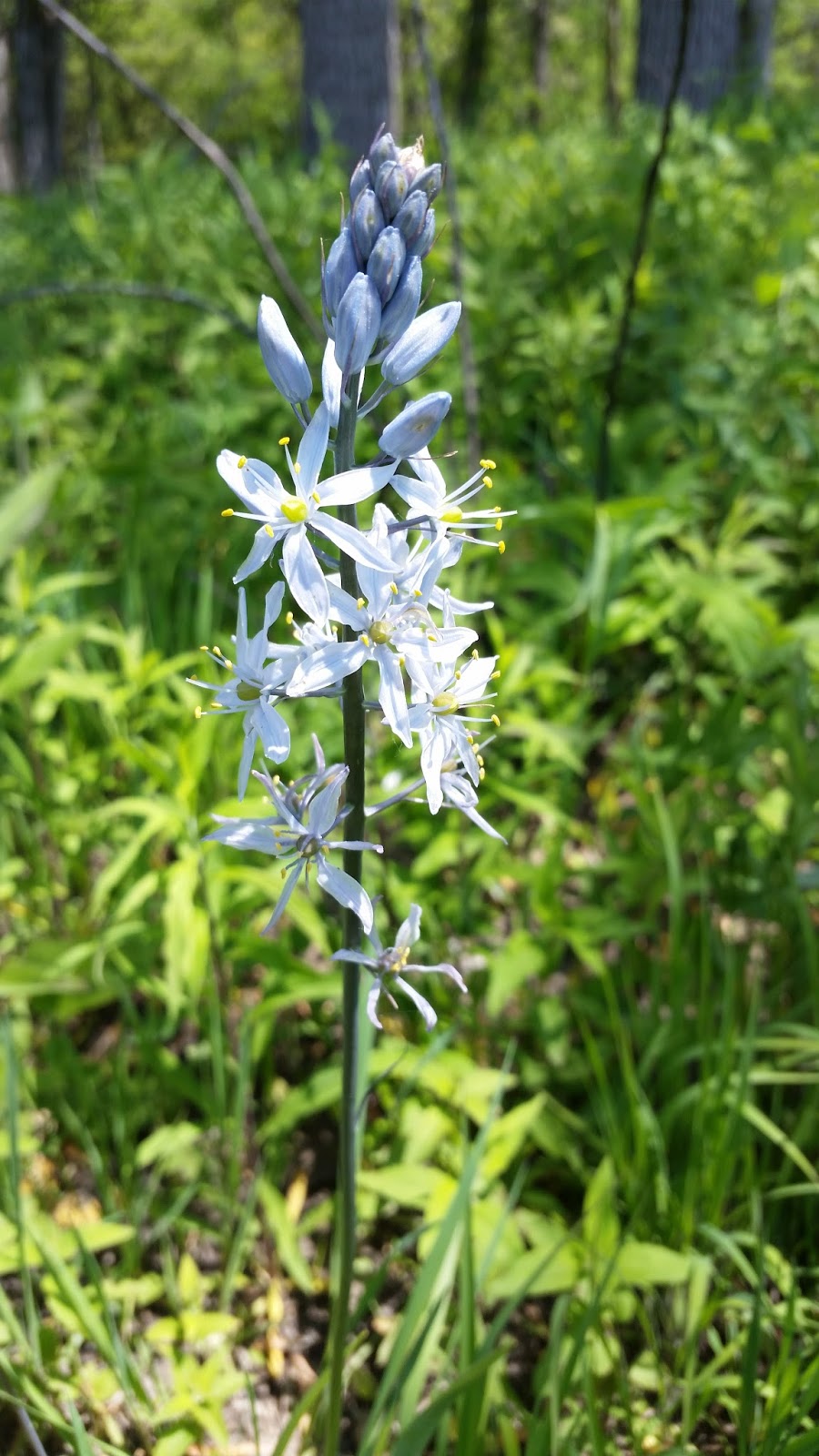
Wild hyacinth was also growing with abandon. Apparently deer love to snack on the stuff, so it's hard to come by in the forest preserves--I guess deer are not allowed in Morton. Some wood betony remained, but it was fading, and cream false indigo was ascending in its place.


High, strong plants looking exactly like asparagus were everywhere--I learned later, on the June walk, that these are young white false indigo.


Now, looking back at my April pictures, I can understand what's going on here.


It's prairie dropseed, with itty bitty sprouting cream wild indigo amongst its soft blades. How sweet! If my theory is correct, here's what this sort of arrangement grew into:

UPDATE: Thanks to Will Overbeck on the Habitat 2030 Facebook page for correcting my guess here...the young plant in the April picture is false toadflax, not cream indigo. 

Here's a mystery for me...this is so distinct a plant, but I don't know what it is. Can someone tell me? Update: It's starry false solomon's seal. Thank you Daniel Suarez!


Sunday, May 8, 2016

A Spring Visit to Schulenberg Prairie

With the help of a Woodlands Spring Flowers class at Morton Arboretum (recommended!), some  books, and the Internet, I have embarked on the next step in my Illinois ecology self-study.

First, I went to Schulenberg Prairie at Morton, one of my favorite places ever, to see what I can recognize. They must've had a burn; everything looks completely different. The prairie is a flat, very green carpet of fresh, low leafy plants--nothing like it was in past visits, when I wandered among grasses and forbs taller than me, whooshing and shushing in the wind.


Pick a spot and look down, and you see it is not a carpet, but a series of tufts and clumps and spots of various colors green.

All those tufts look like prairie dropseed to me, but I know very little. Maybe they are another type of grass or sedge. (Now that I know just how very little I know, I want to be able to name everything.) These tufts were everywhere, with endless constellations of young-bright leafy plants filling in the gaps between.

This plant creates these lovely fairy-circle patterns. At  the time I thought this was the same as those tufty prairie-dropseed clumps, but looking at the photos now it seems clear they are different.  Can anyone help me identify them? Comment or email me!

In the spring, seeing all the textures and rhythms of the prairie requires zooming in--just looking at a couple square feet. Look at this lovely grass, wood betony, and compass plant composition.


The rain brought out the luminous, delicate qualities of the spring blooms, such as this shooting star.


I also saw trout lily, golden alexander, toadshade trillium, and more. This caught my eye, but I don't know what it is. Can someone help me identify it?


After an hour communing with the prairie, it was time for the Woodlands class, taught by the knowledgeable and enthusiastic president of the Illinois Native Plant Society, Chris Benda.

And then, last week, I was delighted to be able to put to use the identification skills learned and practiced in class on my lunch hour at work! More on that coming up.