Tuesday, June 28, 2016

What a difference a month makes...April to May at Schulenberg Prairie

I've returned to Schulenberg Prairie in May and June to check out the prairie's changes since my April visit. The June photos'll come later. Here's the April to May transition. You might recall in early spring the prairie had recently been burned and things were just beginning to grow.

This was taken April 27.


And the photo below, a little ways down the path, was taken May 22.


Look at the growth in prairie dropseed between April 27 and May 22...


...And look how the plants' growth changed the texture of the landscape.


In April I saw shooting star, wood betony, little baby prairie dock leaves, the prairie dropseed fairy circles.

In May the shooting stars remained--flourished--there were whole fields of 'em, not just hardy early-birds.


Here's a closeup of these pretty flowers.


Compass plant and prairie dock had emerged. I think of these large-and-distinctive-leaved plants as anchors or signposts in the prairie reefscape.


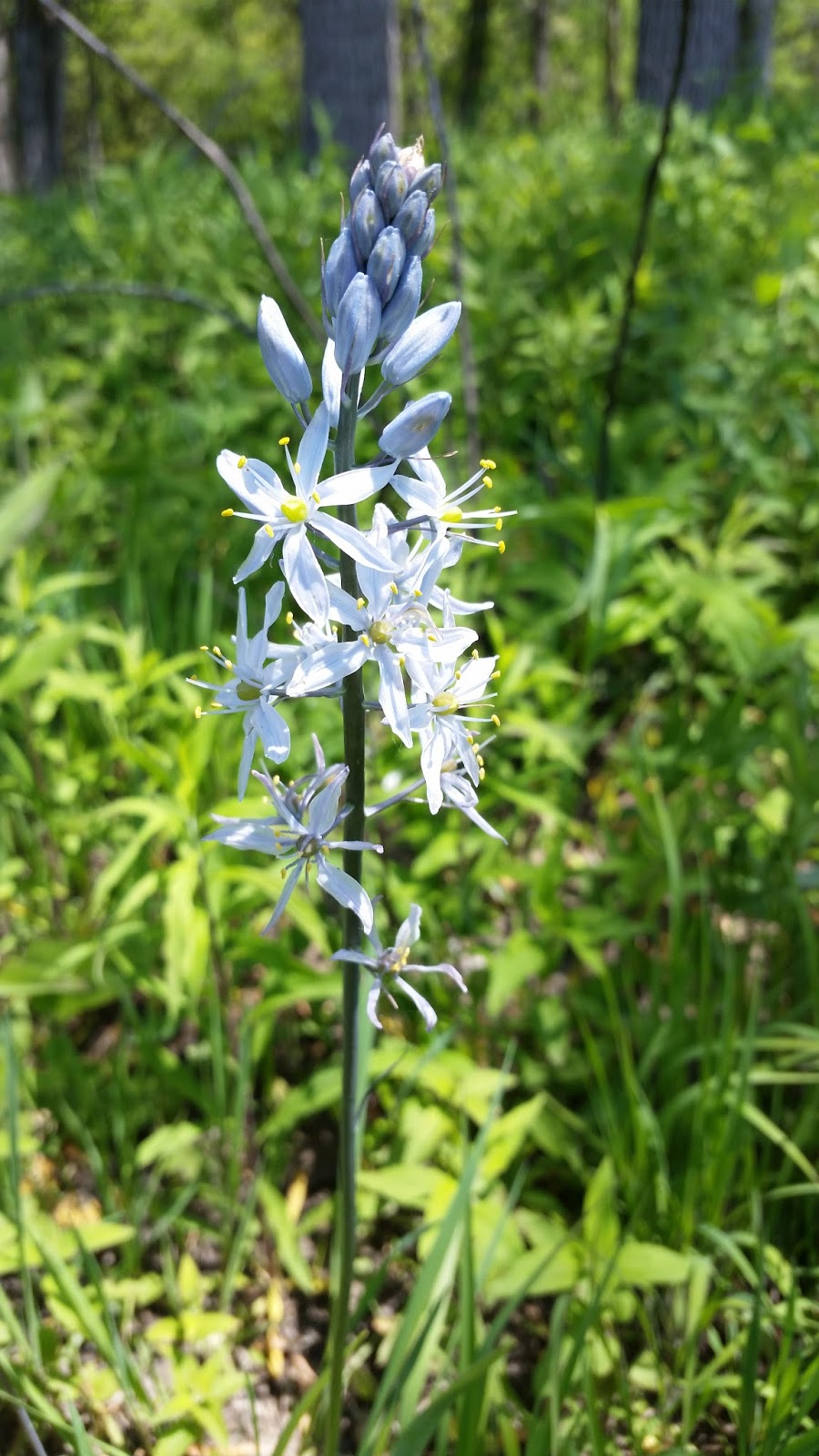
Wild hyacinth was also growing with abandon. Apparently deer love to snack on the stuff, so it's hard to come by in the forest preserves--I guess deer are not allowed in Morton. Some wood betony remained, but it was fading, and cream false indigo was ascending in its place.


High, strong plants looking exactly like asparagus were everywhere--I learned later, on the June walk, that these are young white false indigo.


Now, looking back at my April pictures, I can understand what's going on here.


It's prairie dropseed, with itty bitty sprouting cream wild indigo amongst its soft blades. How sweet! If my theory is correct, here's what this sort of arrangement grew into:

UPDATE: Thanks to Will Overbeck on the Habitat 2030 Facebook page for correcting my guess here...the young plant in the April picture is false toadflax, not cream indigo. 

Here's a mystery for me...this is so distinct a plant, but I don't know what it is. Can someone tell me? Update: It's starry false solomon's seal. Thank you Daniel Suarez!


Saturday, May 28, 2016

Children and Nature Network 2016 conference debrief

I've just returned from the Children & Nature Network International Conference and it was just love all around. It is always validating and inspiring to be among people who share your values and ideals--particularly when those people love children and animals. I feel energized and focused personally and professionally. I think the main takeaway is The Future is Here. To whit:

1) Buildings don't have to keep doing things the same way. Conventions don't have to keep doing things the same way.

The location of the event was the St. Paul RiverCentre, a model of sustainable practices. Think about the last time you went to a major convention or conference. Did you notice all the horrible waste? I always do. Paper programs, plastic bottles, cups, and utensils, no recycling, over-air conditioned rooms, lights on everywhere. The RiverCentre uses windsourced energy and green cleaning products. They have recycling and composting receptacles everywhere. Their "plastic" cups and cutlery are compostable! They capture and use natural light. They are LEED, Green Globe, and APEX/ASTM certified. Of course, all this saves them an immense amount of money, now that it's in place, in energy savings, trash hauling, and other factors. Buildings don't have to keep doing things the same way. Conventions don't have to keep doing things the same way.


2) Mayors must be responsive innovators. People who elect mayors must expect responsive innovation.

St. Paul's mayor, Chris Coleman, is no-b.s. serious about doing things in a reasonable way that makes sense with today's world. "Good things happen when you put children at the center of policy," he said in the opening plenary--and by all accounts, it looks like he means it. He outlined seven additional principles, starting with "Cities are leaders and innovators." Chicago, I'm afraid, seems to do its best in many matters NOT to innovate.

Other Coleman principles include: All city departments play an important role; public input is important; partners are crucial to sustaining impact; all the levels of government need to be involved; equity, sustainability, and greenspace have a role in design; and you need vibrant spaces and places for people of all ages. How many of these does Chicago's leadership do? More importantly, perhaps: How many of these do we Chicagoans expect of our leadership?

3) The environmental movement might finally be getting smart about authentic transformation that puts forward a diversity of young environmentalists as leaders and partners, not as "inclusion goals."

CN&N's Natural Leaders is a diverse group of young, talented, charismatic, and dedicated conservation leaders. They featured prominently in the event on a number of levels, and the difference in the level of conversation about youth and diversity, about the movement's present and future, was clear in comparison with other conferences I've been to. Not that there's not more work to do, a lot more work. But I feel like CN&N has made some smart moves in this realm. The tired, somewhat colonialist talk of "inclusion" is being retired to make way for notions of partnership, connecting, and capacity building.

4) The future is not top down, nor bottom up--it's a living, changing network.

CN&N focused a lot on networks -- not just "networking," but on the power of network weaving for collaboration, support, resource mining and sharing, and planning among organizations. In our resource-poor field (current America doesn't care a ton about children or nature) in our super-connected world, learning and leveraging these tools will be very powerful.

I've brought home with me a ton of ideas from the conference. I can't wait to get started.

Thursday, May 26, 2016

This week's chewy question: What is the goal of our state flower?

I've been chewing on an interesting question that came up during the Morton Arboretum Spring Woodland Wildflowers class.
Kankakee mallow
http://www.illinoiswildflowers.info/savanna/plants/kk_mallow.html
Chris Benda of the Illinois Native Plant Society was talking about the Kankakee mallow, an extremely rare flower--one that was until recently thought to be  extinct--found only on an island in the Kankakee River.

There is a movement afoot, he said, to declare the Kankakee mallow our state flower, replacing the violet, a pretty but extremely common, almost pest-like flower chosen by schoolchildren over a hundred years ago.

Changing the state flower has become a bit of a rallying cry for folks in the botany-know: "Don't be shallow; vote for mallow!"


Common blue violet
http://www.illinoiswildflowers.info/savanna/plants/cm_violet.htm

So that got me thinking. What is the point of having a state flower? Is the point to highlight rarity, or to highlight shared experience? Should the state flower be special to botanists or to schoolchildren?
Is the point of a state flower to advise residents to heed the warnings of extinct, or nearly extinct, or extirpated flowers past? The state flower could be a powerful symbol to remind people that unique living things are lost without stewardship. But do we want to lead with near-extinction insofar as getting young people interested in nature? Do we want to integrate near-total habitat destruction into our state symbols?

On the other hand, is it a good idea to choose as our state symbol the most common and unchallenging image possible? What is the point of that? What action, image, or feelings does that galvanize in Illinoisans?

There aren't a lot of guidelines for states choosing state flowers. Many states haven't even chosen native blooms. So I'd be very interested in your thoughts on this question: Why does Illinois have a state flower?