I've just returned from the Children & Nature Network International Conference and it was just love all around. It is always validating and inspiring to be among people who share your values and ideals--particularly when those people love children and animals. I feel energized and focused personally and professionally. I think the main takeaway is The Future is Here. To whit:
1) Buildings don't have to keep doing things the same way. Conventions don't have to keep doing things the same way.
The location of the event was the St. Paul RiverCentre, a model of sustainable practices. Think about the last time you went to a major convention or conference. Did you notice all the horrible waste? I always do. Paper programs, plastic bottles, cups, and utensils, no recycling, over-air conditioned rooms, lights on everywhere. The RiverCentre uses windsourced energy and green cleaning products. They have recycling and composting receptacles everywhere. Their "plastic" cups and cutlery are compostable! They capture and use natural light. They are LEED, Green Globe, and APEX/ASTM certified. Of course, all this saves them an immense amount of money, now that it's in place, in energy savings, trash hauling, and other factors. Buildings don't have to keep doing things the same way. Conventions don't have to keep doing things the same way.
2) Mayors must be responsive innovators. People who elect mayors must expect responsive innovation.
St. Paul's mayor, Chris Coleman, is no-b.s. serious about doing things in a reasonable way that makes sense with today's world. "Good things happen when you put children at the center of policy," he said in the opening plenary--and by all accounts, it looks like he means it. He outlined seven additional principles, starting with "Cities are leaders and innovators." Chicago, I'm afraid, seems to do its best in many matters NOT to innovate.
Other Coleman principles include: All city departments play an important role; public input is important; partners are crucial to sustaining impact; all the levels of government need to be involved; equity, sustainability, and greenspace have a role in design; and you need vibrant spaces and places for people of all ages. How many of these does Chicago's leadership do? More importantly, perhaps: How many of these do we Chicagoans expect of our leadership?
3) The environmental movement might finally be getting smart about authentic transformation that puts forward a diversity of young environmentalists as leaders and partners, not as "inclusion goals."
CN&N's Natural Leaders is a diverse group of young, talented, charismatic, and dedicated conservation leaders. They featured prominently in the event on a number of levels, and the difference in the level of conversation about youth and diversity, about the movement's present and future, was clear in comparison with other conferences I've been to. Not that there's not more work to do, a lot more work. But I feel like CN&N has made some smart moves in this realm. The tired, somewhat colonialist talk of "inclusion" is being retired to make way for notions of partnership, connecting, and capacity building.
4) The future is not top down, nor bottom up--it's a living, changing network.
CN&N focused a lot on networks -- not just "networking," but on the power of network weaving for collaboration, support, resource mining and sharing, and planning among organizations. In our resource-poor field (current America doesn't care a ton about children or nature) in our super-connected world, learning and leveraging these tools will be very powerful.
I've brought home with me a ton of ideas from the conference. I can't wait to get started.
Robin Wall Kimmerer is one of my heros, and I was so pleased to hear she was on the On Being podcast. I loved listening to her musings in the show on the animacy of all living things, and soaking in the love and wonder she has for the natural world. Hearing her re-sets me squarely in the understanding that my path is plantward.
I love this idea. The Daily Beast reports on Stephen Knolls School in Maryland, which has a sensory garden for children with disabilities. There are systematic opportunities to use the five senses in exploring the plants and flowers of the garden. Garden arrangements of different colors, textures, sounds, smells, and even tastes are included.
But beyond that, they also provide "vestibular, proprioceptive, and kinesthetic input." What? That means input related to our body's "movements, position, and balance. Swinging high in the air, squeezing into a nook, or rolling down a hill might provide these sorts of sensory input."
Neat!!
What an amazing place for anyone--and it's especially wonderful that it's meant specifically and especially for kids who cannot access experiences many of us take for granted.
I also am giddy about the idea that there is an organization called the Therapeutic Landscapes Network. Must! Learn! More!
H.e.a.r. Chicago Talk's next theme is "Access." What an apropos article to come across.
I am taking a summer ecology class at the beautiful and treasured Morton Arboretum. Every Tuesday for four weeks we meet and learn about tallgrass prairies, plant and animal communities, and the wily and wicked-tricky nature of plant identification. Here's what I've learned so far:
The roots of lawn grass go down like 4 inches at most. The roots of prairie grass goes down...guess. They go down five to ten FEET. That way, they reach water from below the ground--they do not rely on rain water to stay alive. They also help prevent erosion. Compare this with lawn grass, which requires regular watering and does little to anchor the soil.
It's a challenge even for veteran ecologists to identify a plant using a field guide. In a true prairie, with the natural diversity of grasses, sedges, and forbs*, there are a great many options for what any given plant might be, and young plants looks different from older ones, plants in bloom look different from those who have gone to seed, etc.
It's even harder to identify plants when things are not in bloom.
*A "forb" is a flowering plant.
There are other great words like "sessile" and "peduncle" and "rhizomous."
Some field guides are categorized alphabetically, which isn't helpful at all for identification, really; but then again, what IS a good way to organize a large inventory of plants? The most user-friendly guides are categorized by color of bloom--but if the plant isn't in bloom, that doesn't help you much. The most thorough ones guide you through a sort of choose-your-own adventure branching scheme: How many petals? Do the flowers form a clump or are they individual? What shape are the leaves (there are all sorts of fun words describing leaf shape)? How do they branch? And so on. From there, you are sent to the appropriate section in the book. But it seems to not work at least as much as it works, and if the plant isn't in bloom the steps sort of break down.
There are more different shapes and qualities of leaves than you ever imagined.
My conclusion is, sort of like with people, you just have to get to know the plants, and then you recognize them intuitively and more or less instantaneously in all their different forms. If you try to recognize them by-the-book, you are as likely to be wrong, and not even close, as right.
Just when you think you've got something straight, you learn that they have changed the latin name of the plant (for example if botanists have reassigned the genus).
Healthy prairies are incredibly diverse--their appearance is hugely different from the mobs of weeds and invasive plants mobbing empty lots, alley cracks, and even most of the tended park areas in Chicago.
They are also buggy.
Unintended consequence: all I see now walking through Chicago green spaces is garlic mustard and bishopsweed ruining everything.
Gentian
Prairie Dock
Purple clover
Wild indigo
The fall ecology class focuses on trees. I am really excited about this! I hope it works schedule-wise.
Morton Arboretum has year-round educational programming for kids--and for teachers, from half-day workshops to participation in masters degree programs.
Note--their lauded and unique certification programs (not just for teachers--available to anyone) are being phased out next year. Let's hope the classes remain, even if the certifications don't--but it's still quite a loss.
This spring I've been applying myself to learning about the State of the Nature here in my native Chicagoland, as my experiences with nature--recreational, pedagogical, emotional--were mostly forged in the Bay Area in California, where I moved after high school and accidentally lived for fourteen years before returning to my hometown. I backcountry camped in Yosemite and Big Sur, went hiking almost every summer weekend on Mount Tamalpais, and sought solace and solitude in walks up Twin Peaks and bike rides through Golden Gate Park and along Ocean Beach. Mount Tam was particularly special to me.
So, I signed up for McHenry County Conservation District's Weekend of Restoration in April, taking place at Glacial Park. MCCD manages over 25,000 acres of open space, including the woodlands, wetlands, prairies, and oak savannahs that marked much of Illinois prior to European settlement. They provide outdoor recreation spaces, environmental education programs for children and adults, and hands-on opportunities for volunteers. Their mission is "to preserve, restore, and manage natural areas and open spaces for their intrinsic value and for the benefits to present and future generations."
We "camped" outside of this interns' bunkhouse, down a gravel road from the visitor's center. Nighttime wind, rain, and temperatures were chilly for the three-season tent I borrowed, especially the first night, but the days were perfect for working--low '60s, abundant sunshine.
Newly created kames, location based on local memory
Nippersink Creek's restored meandering curves
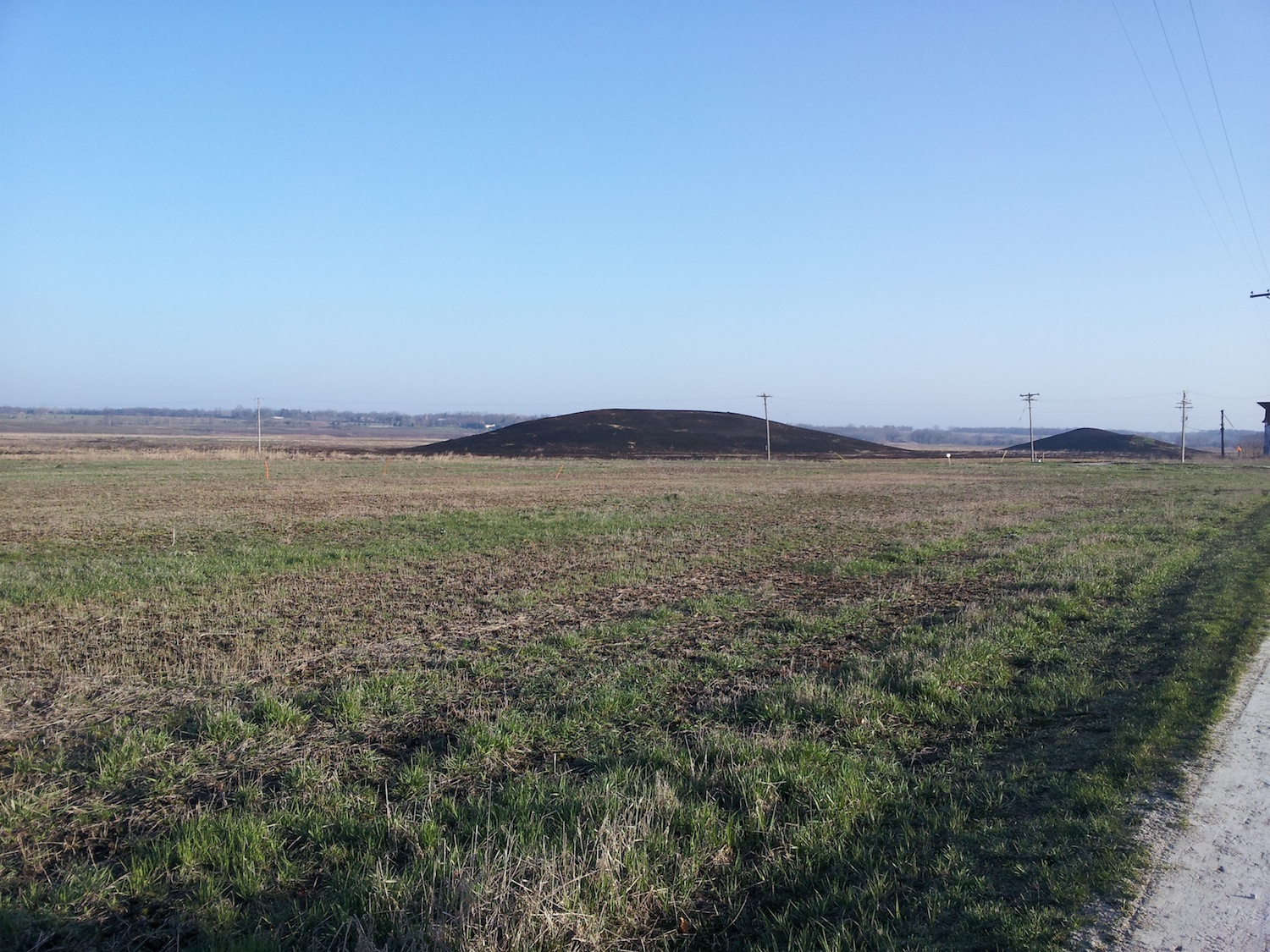
MCCD's restoration work is focused on removing or controlling invasive species and restoring the landscape to its pre white-settlers appearance. (The Weekend of Restoration facilitators made a point to observe that what one considers a "restored state" is arbitrary and, in this case, ethnocentric, as, of course, Native Americans manipulated the landscape as well.) Settlers first came in the mid 1800s to farm; in the first half of the 20th century, they got more ambitious with the expanse and extent of their cornfields, flattening out kames (hills formed from glacial deposits), straightening and damming creeks and rivers, and filling in wetlands with soil and thirsty invasive plants.
McHenry County staff have pieced together clues from ecological considerations, physics, and living memory about how the landscape used to look. From elderly folks who lived in the area as children, they learned hazel bushes grew in thickets and oak trees often grew nearby; so, our task for the Weekend of Restoration was to plant 300 oak and hazel bush saplings on a rise near a (newly restored) marsh.
The term "restoration" is in the weekend's title has two meanings, as the weekend is meant for personal as well as ecological restoration. We learned as much about local history and folklore as we did about the local ecology and restoration methods, and there were readings, discussions, and activities meant to help us identify our personal connections to the area and the work we were doing. Also, the food was excellent.
We visited a beautifully preserved mid-19th century farmhouse on the property and learned about its history and restoration. Unfortunately, I don't have photos of the inside.
Regular ol' 19th c. farmhouses like this one are rare, as most have long been torn down
The first evening we went for a night walk, led by ecologist Tom Simpson. We walked among kames, through prairies and past marshes, as night took over and bugs and frogs started calling. We were standing next to Turtle Marsh, which, Tom was telling us, had in 2011 and 2012 been recovered from underneath farmers' fill and ringed with tree seedlings--when we heard a frog chirp or two. Tom fell silent for a moment, and then said, with reverence and emotion, that the frogs must have have discovered and recolonized the newly restored area--that this is the first time frogs had been heard here. It was a lovely moment.
Here is the new marsh. I know it doesn't look like much, but, in the eyes of those who had worked on it and the other MCCD faithfuls, it was a beautiful, treasured thing--and I have to say, that reverence was pretty catching. Our planting area is in the foreground.
Here we are walking to the site--the marsh is to the right of the photo.
Placing saplings next to holes
My first of many plantings
I have no personal or childhood connection to Illinois wetlands and prairies, and, while ecologically important, they are not terribly eye-catching--I mean, not the way Mount Tam is, or Yosemite, or Big Sur. So being around a group of people who loved this land, nurtured it, provided for it, and hoped for it as they would a child was personally and pedagogically helpful for me. I see so much more in these areas now, and I also know how very important to cultivating stewardship it is to help children and adults discover a strong, and in some ways private, personal connection.
There are more wondeful photos of this weekend on the event's Facebook page, here.
MCCD also has some pretty awesome sounding education programs--professional development for teachers as well as programs for schoolkids and families--on my list for further investigation.
An IslandWood educator, Maddi Sullivan, offered a few corrections to some inaccuracies in my blog post about IslandWood. I'm writing them here and also updating the original post:
1. The Mill Pond is technically down at the harbor, rather than where the Floating Classroom floats. Its sectioned off from the rest of the harbor and is how the big logs were transported from ships etc into the mill. During the waning tide the logs would get dumped and they'd enter the mill pond and the gate would be shut to keep them from exiting as the tide rose. The pond with the Floating Classroom was created during the time of the great mills but it was simply a small stream that was dammed for drinking water etc in the dry months. There would have been no way to get the logs from that pond up at higher elevation and a couple miles away, down to the mill via water.
2. We don't have rain boots for kids to borrow, but just about everything else: rain jackets and pants, warm fleece jackets, hats, gloves etc.
3. "in the dining hall, where kids serve themselves buffet style"---the kids actually eat family style, not buffet. So one kid brings platters of food to each table and everyone serves themselves from them.
[UPDATE 4/16/13] An Islandwood educator, Maddi Sullivan, offered a few corrections to some inaccuracies in this post. I'll note them as updates below. Thanks, Maddi!
I had the opportunity to go to Seattle a few weeks ago, and while there I grabbed the chance to visit four exciting elementary-school programs that get kids doing science outside. Three of these are sibling non-profits and the fourth is based in a Seattle public K–8 school. This post is dedicated entirely to IslandWood's flagship School Overnight Program for fourth- through sixth-graders. I'll address the other programs in subsequent posts.
IslandWood is a 255-acre outdoor learning center located on Bainbridge Island, a half-hour ferry ride from Seattle. The site is old logging land formerly owned by Port Blakely Tree Farms; the ground near the mill is still springy from mounds of sawdust beneath the dirt, and on the mill pond where men used to float logs for transport, a floating classroom now carries kids collecting water samples.
[UPDATE] The Mill Pond is technically down at the harbor, rather than where the Floating Classroom floats. Its sectioned off from the rest of the harbor and is how the big logs were transported from ships etc into the mill. During the waning tide the logs would get dumped and they'd enter the mill pond and the gate would be shut to keep them from exiting as the tide rose. The pond with the Floating Classroom was created during the time of the great mills but it was simply a small stream that was dammed for drinking water etc in the dry months. There would have been no way to get the logs from that pond up at higher elevation and a couple miles away, down to the mill via water.
The center is the compassionate, careful, and thoroughly researched implementation of its founder’s vision. Seattle-area resident Debbi Brainerd bought the land with her husband Paul in 1998 for the express purpose of creating a "magical place" where Puget Sound area children could learn about the region's natural and cultural history.
Forest...one of IslandWood's five distinct ecosystems
The mill pond, another ecosystem
The cattail marsh, a third ecosystem and the location of a bird blind.
Today, about 4000 students from over 70 Puget Sound schools, including about 50% of Seattle's public school students, participate in IslandWood's four-day School Overnight Program annually. Rain or shine, fourth- through sixth-graders are outdoors for most of their waking hours, using the plants, water, wind, and sun to do academic work that other kids are using textbooks for.
The center was developed by the design firm Mithun, known for environmentally sustainable architecture, and is gold LEED certified.
Buildings are located and positioned for minimal impact on ecosystems and watersheds. Windows are placed and angled to capture sunlight in the winter and maintain shade in the summer; dirty water is filtered through shale-and-plant cycles with the goal of reuse; rainwater is collected in cisterns and organic waste is composted. Buildings have solar panels, skylights, and sound panels to capitalize on natural energy and physics.
Countertops are made of recycled yogurt containers (you can still see the foil) and bathroom stalls of plastic milk bottles. Panels, floors, beams, and doors are constructed from reclaimed or sustainable wood and building insulation from old newspaper. Artwork and ornamentation are made by local artists from locally sourced and/ or recycled material.
Yogurt-container countertop in a classroom
A Muir quote etched in a Mobius circling an old milled beam
Student-made sidewalk mosaics
Glass-bottle bathroom tiles
Each of these elements is made explicit to kids as they come into contact with them. Everything at IslandWood, in fact, is optimized for teaching moments. And everything is kid friendly. The place was made for kids--not (only) for adults who want kids to pay attention and learn things. Hundreds of chlidren were consulted for the center's creation.
That is why at each bunk there is both a forest-facing window and a little nightlight.
That is why the benches of the "Friendship Circle," the outdoor amphitheater, subtly demarcate individual seats (children of a certain age need their space, even in friendship circles).
It goes without saying that kids requested a treehouse.
People, there's a treehouse!!
It is constructed by the local Seattle outfit Treehouse Workshop with meticulous attention to the health of the tree.
Every student gets a science journal for sketches and notes--some prompted, some open--about plants, animals, water, air, and earth. Kids climb a canopy tower to compare tree features, weather, and humidity at the different heights.
They do scientific investigations of water quality and soil type; they study ecosystems, animal tracks and scat, and orienteering. They observe plants and animals from a bird blind in the marsh, a boat on the pond, and a suspension bridge over a ravine, among other places.
Bird blind
Suspension bridge
There's a place to check out boots and coats, so no one needs to worry about staying warm and dry. [UPDATE] Actually, IslandWood doesn't have rain boots for kids to borrow, but just about everything else: rain jackets and pants, warm fleece jackets, hats, gloves etc.
There's a garden and a beehive; kids learn to make a snack from fresh-picked food from the garden.
Classrooms are multi-level, because children love going into their own corners, and because the architects wanted to break up the literal and metaphorical flatness of the classroom. The multi-level design also aids in the functioning of barrel-and-tube models of watersheds, as gravity is an important component.
Education at IslandWood is predicated on gentle experienced insights into the interconnectedness of resources and actions. This is as effective a social principle as a scientific and ecological one: in the dining hall, where kids serve themselves buffet style, there's a leftover-food weigh-in station. [UPDATE] The kids actually eat family style, not buffet. So one kid brings platters of food to each table and everyone serves themselves from them.
At the end of the meal, students weigh what's left on their plates and compete by table for the least amount of food wasted; numbers are significantly lower by the end of the week. (I would love to see this used for math-lesson teaching moments as well as a resource- and waste-awareness ones.)
IslandWood curriculum is mostly science, but integrates other important areas of learning as well--specifically those areas that teachers report get lost in the standards and accountability churn. Artists-in-residence provide curriculum in the arts, while mill structures and a cemetery are fodder for social studies.
These subjects are combined in the lessons of instructors from the area's Native American communities, who work with students on songs, crafts, and other traditions.
(All photos taken by H. Lukic or me, but this video is from IslandWood's YouTube channel.)
IslandWood encompasses so many elements of my dream school. Just getting out into green spaces is important for physical and emotional health, but that's only the beginning. Students on the School Overnight Program get to experience nature to an extent and in a manner that will likely engender stewardship of natural resources. There is sustained interaction--four days at the center, with two thirds of the day spent outdoors. And--so important and fulfilling in my mind--kids also learn important academic skills and concepts through experience and exploration, guided by mentors and coaches. Children who aren't focused or interested in classrooms often respond strongly and positively to experiential learning, especially outdoors.
The chimney in this lodge conveys the region's geologic history
Art, science, and learning are everywhere
In my dream world, IslandWood is a year-round school.
A slightly (...slightly) less wildly unrealistic dream is of a school system that allows for full, authentic integration of IslandWood-like programs. Imagine a school set-up that facilitates as part of its regular everyday curriculum repeated visits to a wilderness area, for example throughout different seasons, or at various times of day. Imagine lessons in math, writing, literature, and P.E. that take place outdoors or respond to outdoor experiences. Imagine curriculum standards, societal expectations, and budgets allowing for thorough in-class followups to wilderness experiences (IslandWood staff are available to visit classrooms after their IslandWood stays, but it is left to individual teachers to make time in their overpacked schedules for this visit--or to connect the residency to class studies in any other way).
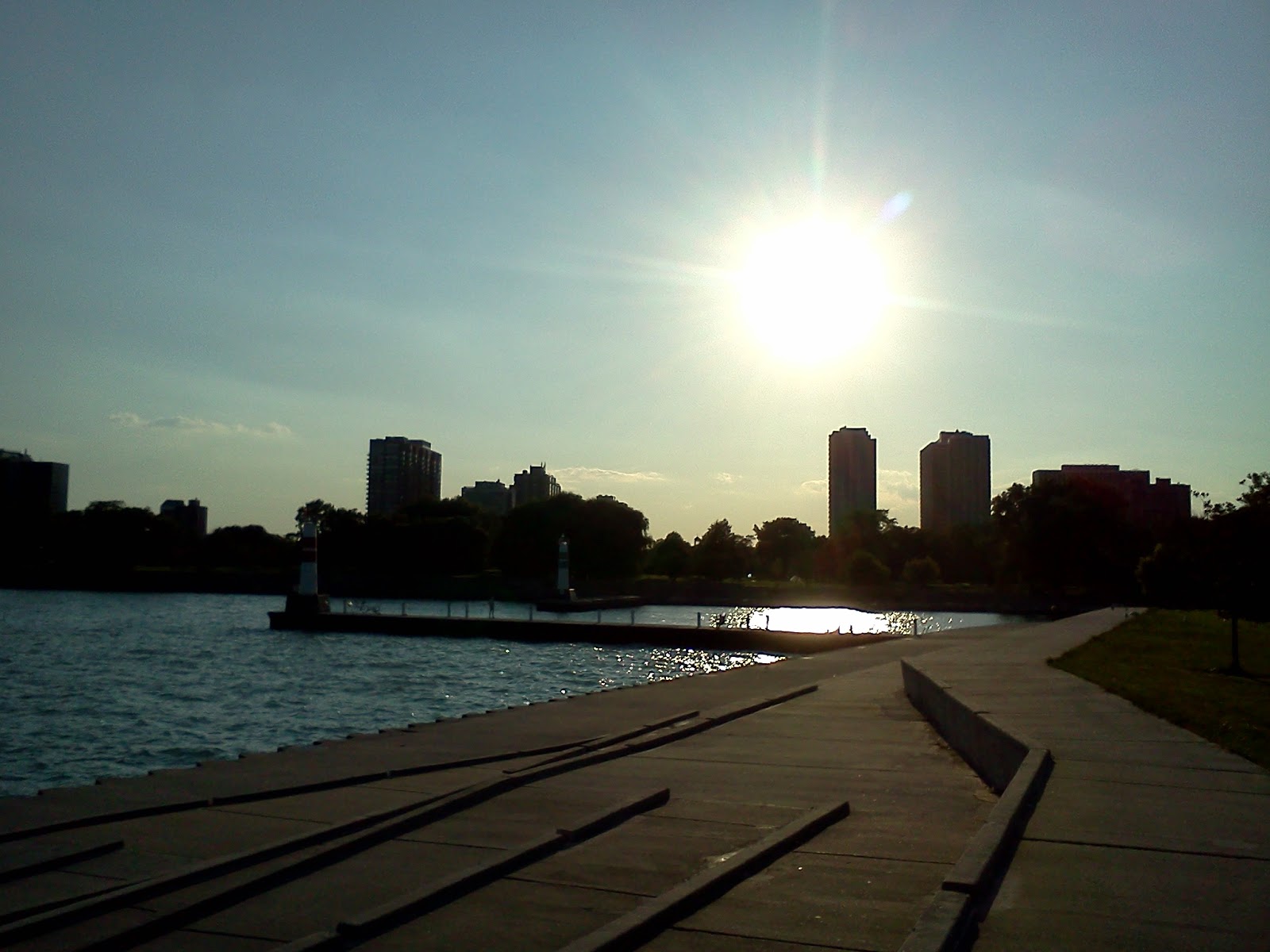
Not everywhere has the natural beauty that the Puget Sound area has, but there is nature everywhere, even in cities. Cultivating health, activity, and environmental awareness and stewardship, as well as opportunities for experiential learning, is important--and possible--everywhere. For example, in my beloved Chicago.
The Chicago River at Wilson Bridge
Beautiful Lake Michigan
North Pond in Lincoln Park
IslandWood was born of the significant wealth of a caring and visionary private citizen and is sustained through grants, donations, and conference and event rentals. The very existence of this amazing place, and the dream of propagating such a model, begs deflating questions about money and public and political will. I'll address those questions in the final post in this Seattle series.
This consortium brings together Chicago clinicians, educators, non-profit leaders in social, educational, and environmental fields, urban planners, and city representatives to develop and implement measures for improving Chicago children's health. Their approach is as varied as their participants: subgroups consider the issue in relation to early childhood needs, food access, physical activity, schools, policy, research, and public education. You can find their blueprint for the next decade here and many other resources here.
I attended because of my interest in integrating nature-based and other outdoors activity into the school day as part of formal education, as I've discussed before in earlier posts. (I am even more excited about this now, having just returned from an amazing and informative trip to Seattle last week! More on that--with pictures!--later.)
At the meeting, we heard anthropologist Howard Rosing, PhD speak about his research on cultural considerations related to food access, and a panel, composed of Kelly Lowry, PhD and Alicia Gonzalez of Lurie Children's Hospital/ Chicago Run, Rush University Medical Center's Brad Appelhans, PhD, and research consultant T. Nigel Gannon, PhD, discuss opportunities and challenges in community-based research design. As you can gather from all those name suffixes, the consortium values its relationships with university researchers and medical doctors--but what I find impressive and refreshing is that it appears equally committed to on-the-ground implementation. When there is a gap between research and application the public loses faith in the value of the research and the researchers lose perspective on practical realities. And, on the other hand, when program developers do not regard authentic grounding in research to be important, programs can become idiosyncratic, narrow, or inconsistent.
Before the meeting adjourned, the interest groups reported on their work earlier that day (mostly, they reviewed the new blueprint, which had been published since the prior meeting) and announced their next meeting dates. I plan on attending the Health Promotion and Public Education meeting next week, and the Physical Activity and the Built Environment one at the end of the month.
The week prior to this meeting, I went to an exciting kick-off meeting for a new food cooperative being put together in Chicago, headed by the tireless and supersmart Greg Berlowitz. The prospect of a community gathering place based on healthy produce and locally produced goods is a welcome one in Chicago (sadly, my beloved town is pokey when it comes to environmental and food awareness, one of the reasons I am interested in building education around these issues)--and I see many possibilities for integrating educational programming.
[Update 6/17: the title of this post has been corrected]
Finally! Some time to write about the Chicago Wilderness Leave No Child Inside conference at Triton College a couple Saturdays ago (you can see my tweets from the sessions here). While its focus was more on the importance of getting kids outside as opposed to full-on nature education, I learned abut a few interesting programs teachers can incorporate into their lessons, particularly their science lessons:
Budburst is a program sponsored by the National Science Foundation where anyone--children or adults, groups or individuals--can contribute to scientists' understanding of plant cycles and seasonal changes by observing trees or plants anywhere at all--in a forest preserve, a city square, or back yard. These "citizen scientists" fill out a very simple form to collect data points. There's a website and a mobile app for ease of collection; folks can do it just once or regularly, for one plant or many. Data points submitted by people all over the country are freely available for anyone to see. There are plenty of resources for teachers on the site. The Chicago Botanic Garden, project Budburst's local partner, has additional resources.
The Alliance for the Great Lakes sponsors beach clean-ups, which not only remove garbage from shorelines and water, but--as important if not more so for the Alliance--provide an opportunity to gather data. Adopt-a-Beach volunteers are encouraged to log the garbage they pick up as well the wind, temperature, and other conditions. Scientists can use this data to understand better how conditions affect the spread of garbage and therefore how to target initiatives for healthier beaches and waters. As wth Budburst, anyone can go to the Alliance website and look at the results of thousands of people's observations.
The Forest Preserve District of Dupage County has an ambitious Citizen Science program in the works. Kids and adults can track animal and plant sitings in Dupage County and submit their reports to the Observe Your Preserve website. A searchable database will be created from these data points combined with basic information about the creatures and plants--it looks like a beta version, at least, is already up.
In all three cases a teacher could coordinate a many-faceted science lesson around observation, data collection, and data comparisons and analysis, as well as anatomy of flora or fauna or weather patterns. There are other resources for teachers on these sites, too, for things to do both inside and (especially) outside the classroom.
The other session that I'm still thinking about was on encouraging ethnic and cultural diversity in the get-kids-outdoors movement. The presentation, about a successful collaboration between the Field Museum and the Bronzeville Historical Society, was fine, but I found the discussion afterward pretty deflating. The presenters asked us what we've done or could do to bring greater diversity to the outdoorsy-kid projects we were engaged in. While, after some initial perplexed silence, participants talked about the importance of building relationships with leaders in the target communities and taking measures to ensure said leaders have a key role in the planning and outreach, few in the almost entirely white audience seemed to have implemented those ideas, at least with any sort of strength or confidence or consistency or success--though, granted, that would be why they were at the session--but nor did I get the feeling the session left anyone feeling more equipped to address the issue in their programs. The discussion just seemed sort of hollow to me. I can certainly sympathize--this sort of reaching out across cultural realms is difficult and fraught with potential gaffes, especially in an ethnic archipelago like Chicago, even more especially from the confines of a distressingly white milieu such as the environmental movement. How to authentically change the demographics of a movement or habit or behavior? It's an important question, and it's certainly not an easy one. Well, here's a pretty thoughtful article on the subject...but the trick is implementation, right?--consistent, authentic, knowledgable, and widespread implementation.
Next month I plan to visit a few nature schools and/ or experiential schools. I'm really interested in where they get their curriculum from, and in how they answer the diversity question.

 The location of the event was the St. Paul RiverCentre, a model of sustainable practices. Think about the last time you went to a major convention or conference. Did you notice all the horrible waste? I always do. Paper programs, plastic bottles, cups, and utensils, no recycling, over-air conditioned rooms, lights on everywhere. The RiverCentre uses windsourced energy and green cleaning products. They have recycling and composting receptacles everywhere. Their "plastic" cups and cutlery are compostable! They capture and use natural light. They are LEED, Green Globe, and APEX/ASTM certified. Of course, all this saves them an immense amount of money, now that it's in place, in energy savings, trash hauling, and other factors. Buildings don't have to keep doing things the same way. Conventions don't have to keep doing things the same way.