Saturday was another stewardship day Saturday cutting buckthorn, this time at LaBagh Woods. The group was large and included a crew of diligent kids from Curie High.
Most of the buckthorn was fairly small—we used loppers and hacksaws. No chainsaw crew on this site. More time consuming than the actual cutting is disentangling the brushy, thorny, spreading branches from other trees. The stuff is like velcro, catching on anything when it falls. Maybe one day I'll actually be able to recognize buckthorn with a degree of certitude, but for now I followed the steward's spray-painted orange marks to know which tree to cut and which to leave. There are hawthorns and oaks in these woods, native flora that belongs in this ecosystem. There is also invasive honeysuckle, which was let stand, with some reluctance, to appease the birding groups, who just want cover for their birds and so operate under different priorities from the restoration folks.
It has rained throughout January and February, but snow has barely fallen, and what has fallen hasn't stuck. On this day it was appropriately seasonally cold and the brushfire provided welcome warmth, but the dusting of snow that came midway through the morning still disappeared almost immediately. I'm glad I snapped the picture when I did. I miss snow.
For break, the stewards grilled hotdogs on the buckthorn brushfire, and a couple called the Martons brought out delicious home-made beans and cole slaw, apparently a regular perk of volunteering at LaBagh. The students also brought marshmallows for roasting, after the work was done.
Note: I made a correction to the name of the food-making couple. Previously I had written "Hortons." Sorry about that, Martons!
I've just returned from the Children & Nature Network International Conference and it was just love all around. It is always validating and inspiring to be among people who share your values and ideals--particularly when those people love children and animals. I feel energized and focused personally and professionally. I think the main takeaway is The Future is Here. To whit:
1) Buildings don't have to keep doing things the same way. Conventions don't have to keep doing things the same way.
The location of the event was the St. Paul RiverCentre, a model of sustainable practices. Think about the last time you went to a major convention or conference. Did you notice all the horrible waste? I always do. Paper programs, plastic bottles, cups, and utensils, no recycling, over-air conditioned rooms, lights on everywhere. The RiverCentre uses windsourced energy and green cleaning products. They have recycling and composting receptacles everywhere. Their "plastic" cups and cutlery are compostable! They capture and use natural light. They are LEED, Green Globe, and APEX/ASTM certified. Of course, all this saves them an immense amount of money, now that it's in place, in energy savings, trash hauling, and other factors. Buildings don't have to keep doing things the same way. Conventions don't have to keep doing things the same way.
2) Mayors must be responsive innovators. People who elect mayors must expect responsive innovation.
St. Paul's mayor, Chris Coleman, is no-b.s. serious about doing things in a reasonable way that makes sense with today's world. "Good things happen when you put children at the center of policy," he said in the opening plenary--and by all accounts, it looks like he means it. He outlined seven additional principles, starting with "Cities are leaders and innovators." Chicago, I'm afraid, seems to do its best in many matters NOT to innovate.
Other Coleman principles include: All city departments play an important role; public input is important; partners are crucial to sustaining impact; all the levels of government need to be involved; equity, sustainability, and greenspace have a role in design; and you need vibrant spaces and places for people of all ages. How many of these does Chicago's leadership do? More importantly, perhaps: How many of these do we Chicagoans expect of our leadership?
3) The environmental movement might finally be getting smart about authentic transformation that puts forward a diversity of young environmentalists as leaders and partners, not as "inclusion goals."
CN&N's Natural Leaders is a diverse group of young, talented, charismatic, and dedicated conservation leaders. They featured prominently in the event on a number of levels, and the difference in the level of conversation about youth and diversity, about the movement's present and future, was clear in comparison with other conferences I've been to. Not that there's not more work to do, a lot more work. But I feel like CN&N has made some smart moves in this realm. The tired, somewhat colonialist talk of "inclusion" is being retired to make way for notions of partnership, connecting, and capacity building.
4) The future is not top down, nor bottom up--it's a living, changing network.
CN&N focused a lot on networks -- not just "networking," but on the power of network weaving for collaboration, support, resource mining and sharing, and planning among organizations. In our resource-poor field (current America doesn't care a ton about children or nature) in our super-connected world, learning and leveraging these tools will be very powerful.
I've brought home with me a ton of ideas from the conference. I can't wait to get started.
You may recall that on February 24, in partnership with Chicago Wilderness and Educelerate, H.e.a.r Chicago Talk looked at educating future eco-leaders, with a focus on fostering diversity. I feel honored to have had the speakers we did and the audience questions were incredible. The recap is below. But first...
Where has H.e.a.r. Chi Talk Been?
Engaged Green Education people!
H.e.a.r. Chicago Talk is a one-woman production and, I discovered this spring and summer, subject to the vicissitudes of circumstance. One of my goals has been to find partners and resources so as to stabilize the forum's place in the world, though that goal clearly remains unmet (more on goals and purposes later).
This one woman is swallowing her shame along with her second cup of coffee right now and imparting to you, finally, news of the Fabulous February event, as well as thoughts on the Flighty Future of our Feisty little Forum.
H.e.a.r Chicago Talk: Green Education recap
We had an AMAZING group of speakers and an equally incredible yield of audience questions.
Pete Lekicreated the Gardens and Ecology Program at Waters Elementary. He offered a poetic description of the Waters program's foundation and growth, accompanied by an evocative montage of photos.
Audience questions for Pete are listed here. Themes (rooted in the realities of CPS today I think), include: How can such school programs survive a challenging district environment? and What is the relationship between shifts in school culture and gentrification, and how can that relationship be disrupted?
Kellen Marshall is a PhD Candidate in the Ecology & Evolutionary Biology Department at UIC and the director of research at Eden Place Nature Center. She presented, via video presentation, some of her research on the gap between educational and experiential requirements typical of conservation careers, and corresponding paths typically taken by Black high school and college students.
A slide from Kellen's presentation
Audience questions for Kellen are listed here. Themes include: How can new and more pathways into environmental work be created? and What changes must be made in both the field and the community to foster diversity in the field?
Dr. Jo-Elle Mogerman is Vice President of Insitutional Planning and Inclusion at the Chicago Zoological Society. She presented the principles and practice of a program at Brookfield Zoo that provides Chicago youth with authentic conservation experiences.
Michael Rizo is an Urban and Community Program Specialist in the Office of International Programs of the US Forest Service. Mr. Rizo talked about his work in partnership with El Valor Children and Youth Services engaging Little Village families in the life cycle of the monarch butterfly via cultural associations as well as ecological ones.
Audience questions for Mike are listed here. Themes include how to replicate a culturally specific program in other neighborhoods and how to extend successes into school and career as participating children get older.
I recommend you take a look at all the questions that came out of the evening!
Whither Goeth H.e.a.r. Chicago Talk?
Each time we have a H.e.a.r. Chicago Talk, I am inspired by great speakers and thoughtful questioners. But nature-based education holds special interest for me, and the Chicago Wilderness/H.e.a.r. Chicago Talk partnership was pretty dreamy for me.
It was clear from the AMAZING questions we got from the audience that our eco-inquiry wasn't over after that event, had barely even started, in fact...we had convened an incredible group of people and now, rather than move to a new topic, I want to dig more into the questions and themes we touched on.
But how? A second green-education forum, a roundtable or study group, set up differently so as to discuss some of these questions in depth? Is that the same as a H.e.a.r. Chicago Talk, or something new?
H.e.a.r. stands for "Hope for Equity, Authenticity, and Relevance in education." Its goal has been to provide a positive place for educators to share ideas about teaching and learning. I have many conflicting thoughts about the extent to which this has worked and whether it can work in its present form and the current education conditions in Chicago.
I confess that at least some substantial portion of my long silence has been bafflement. Where do I go from here? What are people getting out of these forums? Perhaps I should focus on just one topic? Perhaps the forum isn't needed at all? Who is the audience? Is it possible to create an event that better appeals to both teachers and informal educators?
I just don't know right now what my conclusion is. I was hoping to know that before publishing this, but, well...it's been a long time and I want to hear from you.
Action! Plan!
No H.e.a.r. Chicago Talks are yet planned at this point. Please:
1) Read the talk summaries and audience questions from Pete's, Kellen's, Dr. Jo-Elle's, and Mike's talks. Comment on the blog, on Facebook, or by email your favorite questions for each speaker. I will collect, publish, and forward! Perhaps people want to address these questions in another forum. I'd love to facilitate that.
2) Think about your experience with H.e.a.r. Chicago Talk. Comment on the blog, on Facebook, or by email on what YOU want to see. What need can it serve? For whom? What does it need? And/or, want to talk about it over coffee? Contact me.
I love this idea. The Daily Beast reports on Stephen Knolls School in Maryland, which has a sensory garden for children with disabilities. There are systematic opportunities to use the five senses in exploring the plants and flowers of the garden. Garden arrangements of different colors, textures, sounds, smells, and even tastes are included.
But beyond that, they also provide "vestibular, proprioceptive, and kinesthetic input." What? That means input related to our body's "movements, position, and balance. Swinging high in the air, squeezing into a nook, or rolling down a hill might provide these sorts of sensory input."
Neat!!
What an amazing place for anyone--and it's especially wonderful that it's meant specifically and especially for kids who cannot access experiences many of us take for granted.
I also am giddy about the idea that there is an organization called the Therapeutic Landscapes Network. Must! Learn! More!
H.e.a.r. Chicago Talk's next theme is "Access." What an apropos article to come across.
Many thanks to those of you have rsvp'd for H.e.a.r. Chicago Talk. I'm getting very excited about this one. I just heard Pasi Sahlberg speak yesterday, thanks to Raise Your Hand Illinois, and, while listening to how Finland employed mature vision, humble intelligence, and faith in its people to strengthen their society is rather deflating because, well, frankly, this sort of behavior is not in the cultural DNA of the U.S, a place with a history of addressing complexities through stridency and slogans--it is also inspiring, or galvanizing, because it helps give shape to problems and solutions.*
Sahlberg mentioned that all of Finland's great edu-ideas--the ones on the right-hand side of slide 14 here, came from the U.S. Say wha? Really?? Which?! Where?! When?! I gathered by the end of the presentation that what (I think) he meant was there are innovative and engaging and pedagogically appropriate and child-developmentally-appropriate and teacher-respectful practices happening at individual schools, and that Finland's really done its research over the past forty years--but there is no mechanism to catalog, disseminate, propagate, and scale these individual and locally occurring ideas.
So. Here's where I get back to H.e.a.r. Chicago Talk. Sharing and amplifying these localized ideas is the exact point of this idea exchange. That's why I started it. That and the need for a counter to the yelling and anger and conflict that's been happening in Chicago and nationally in edu-fields. H.e.a.r. Chicago Talk is meant to be a place where great ideas can be shared and those who reach and teach can feel inspired and re-charged.
There is so much to learn from Finland's experiences. Let's start by sharing and learning from our own great ideas.
I wish we didn't have to rely on corporations and foundations backed by billionaires to fund our basic civic resources, like libraries and schools (a three-year school improvement grant that provided vital services and support for the most challenged Chicago schools is ending this year...and all these programs put into place are expected to just continue on somehow without support, staff, or funding). But--it's nice to learn here that our library gets its exciting and innovative Maker Lab for one more year. But really. This ever-accelerating move toward oligarchy. This withdrawal of public funds for public services. What are we doing, y'all? In happier news, May 10–18 is Urban Biodiversity week. I had a heck of a time fnding the website through a Google Search, so I've put it here. You're welcome. Have fun. Watch for ticks. :)
In April I visited North Park Village Nature Center, a miraculous little jewel of a preserve on the Northwest side, on land that used to be a tuberculosis sanitarium and somehow escaped development. I didn't manage to post about it, but that's okay, because I went again today and now I get to put pictures from two different seasons side by side.
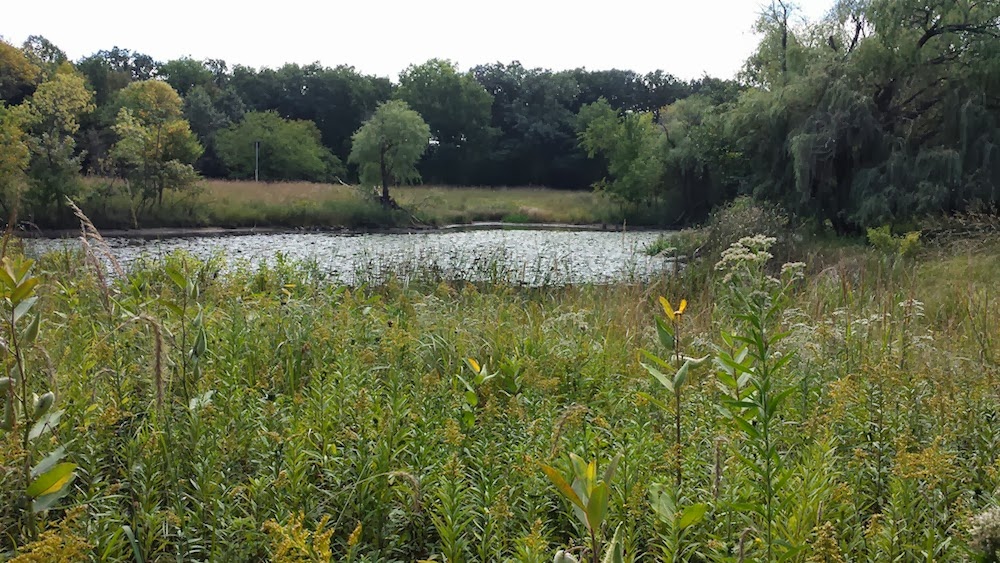
This pond can be seen from the Wetlands area, which is one of my favorite locations in the preserve. Here's the wetlands path in two seasons.
It looked so different today from my April visit, when foliage were dried, flattened stalks. The variety and wild abundance of plants today was impressive.
You couldn't see anything over this wall of foliage. I think the pond was behind there--in the spring it looked something like this.
I love the North Park Village wetlands in their wintry state, too, though. On mild days in the winter and spring, it's the sunniest, warmest place around.
Around the education center in the Woodland area, near the bird blind, the cicadas were out in force. I never noticed this bird blind before.
Near it are feeders, and inside it are signs about different bird types and behaviors you might see according to season.
When I visited in April, there had been abundant rain, and the west side of the woodland area had flooded.
It was much friendlier looking today.
Deer are often visible in the woodlands area. I know they're very
common--a pest in many areas, a danger
because of road collisions--but I still find them majestic and calming. You can see them any time of year. Look carefully: there are two visible in each picture. I wonder if they are the same two?
The Nature Reserve is a real respite from concrete, but we are still in the city, hemmed in on the west and the north by busy thoroughfares, and the traffic sounds are intrusive, especially near the woodland area. My eyes need to not-see concrete, and I love coming to the preserve for that. But my ears need to
not-hear city din, and that's harder to
accomplish in Chicago.
The Oak Savannah area hosts my favorite tree. I always make sure to go by and say hello.
This time, it was lushly dressed.
I didn't see any snakes this time, as I had in April. When I was a kid, I loved finding pretty, sweet little garter snakes in our tiny front yard. At North Park, a lady walking by pointed this one out.
I picked it up gently, assuring a family watching nearby that it wouldn't bite, and one girl bravely held it herself--those are her hands in the picture. A month after this walk I participated in a restoration project in McHenry County, where the garter snakes are significantly more feisty, apparently, because I picked one up and it nipped me, drawing blood. I'm really glad I didn't get those kids bitten by a snake. That would have been embarrassing.
There are interpretive signs throughout the reserve, though some are quite weathered, and information about volunteers' restoration efforts.
I went to the center on a brutally hot day in July to chat (indoors) with the resident educators there, Liza and Sean. They have tirelessly created a multitude of ways to engage with children of all ages. There is a Maple Syrup Festival in the spring, where children learn all about sap and then help tap trees, and Monarchpalooza in the fall, where kids observe butterflies' life cycles and then help tag and release those ready for migration. There are interpretive encounters with birds, bees, trees, bugs, plants, and woodland mammals for school groups and families. Kids participate in conservation and restoration days through the park district's Mighty Acorns and an organization called El Valor, which has sort of adopted North Park as the location for some of its community-building goals. Sean and Liza have created Neighborhood Naturalists, a multi-season, multi-visit program for third grade classrooms. And of course there are camps all summer.
The Center also supports new, independent program ideas--Sean told me one woman organized some open-play mornings for children, in the middle of winter. Everyone was a little anxious about the lack of structure and the freezing temperatures, but the children found plenty to do and weren't bothered at all by the cold.
Community activities for adults abound, as well. There are yoga, fly-fishing, and art classes, story-guild nights and lectures.
I love coming to this urban Island of Children Playing in the Woods. Wouldn't it be amazing if this were what our classrooms looked like? What if kids of all ages read and wrote about seasons, used trees and hills to measure and calculate, leaves and breeze to learn about gravity and friction?
One of the folks I met on the Hegewisch Marsh tour is Gavin Van Horn, a director at a thoughtful, heady sort of thinktank called the Center for Humans and Nature. Gavin described the organization's work as exploring ethics and nature; its website explains that it partners with "philosophers, biologists, ecologists, lawyers, political scientists, anthropologists, and economists" to explore the relationships between humans and nature--"to think creatively about how people can make better decisions."
They do this through projects, events, and writings via their journal and blog--and by posing thought-provoking questions that scholars and experts in various fields then answer, and that readers are also invited to comment on. One of their recent questions is "How is nature critical to a 21st-century urban ethic?" This question drew me, since, as you will know if you've been following my blog, I've been exploring ways educators incorporate urban green spaces and other nature into K-12 education. And this answer, penned by nature writer and scholar John Tallmadge, just said it all for me. I tried to pull quotes but it's so lovely and wise and true in its whole that I didn't want to pull it apart. Just read it.
And once you've read it, then (and only then--seriously, go to the link first. You won't regret it) reread its final words:
So the real question is not how to bring nature back into our cities; it’s already there. It’s what makes every neighborhood, no matter how blighted, a landscape of opportunity. All we have to do is wake up and embrace the possibilities. Make ecological literacy a core value of education and reconciliation ecology a guiding principle of design. That will take us a long way toward preserving the world through an urban practice of the wild.
I wrote all about IslandWood, a Seattle area outdoor education center with a four-day school overnight program, in a previous post. While in Seattle I also visited Brightwater, a pretty awesome wastewater treatment plant serving King and Snohomish Counties that offers educational day programs. The facilities are maintained by King County, but the programming and staff are IslandWood affiliates.
Brightwater Treatment System opened in 2011 in Woodinville, WA on a site previously used for smelly industrial purposes. Residents were not necessarily thrilled at the prospect of replacing the soup factory and auto junkyard with a sewage treatment plant, but someone over at King County's wastewater treatment division had a vision. The plant goes beyond simply minimizing negative impact to actually contributing positively to the region's environmental health and community. You can learn all about it on one of their public tours.
In addition to the plant, the complex contains paths, ponds, native flora and fauna, and an education center with exhibits and labs.
The treatment plant is in the background; the nearer building is part of the education center
The education center exists thanks to the cooperation of King County officials, environmental groups, local Native American groups, and a dedicated and tireless group of schoolteachers from the region called Friends of the Hidden River. These incredible teachers raised over a million dollars for the center! The platinum LEED certified education center, designed by Mithun (who also designed IslandWood), has a smorgasbord of environmental and sustainable features, including renewable energy sources for heat and reclaimed wood for construction.
Not that it's all been Woodinville wine and Pike Place roses...the project, which ran behind schedule and overbudget, was a source of concern and frustration for residents prior to its opening. It appears, though, that with two years of excellent programming for schools and the public, a clean and attractive facility, and a positive contribution to the ecological health of the region, residents are coming around.
The day program is for kids grades 3–8 (about 4400 of them this school year). The programs are aligned with area schools' science curriculum; the older kids study human impact on the water cycle at the treatment facility while the younger study landforms and ecosystems at the learning center and its nearby ponds and trails. The day I was there, I shadowed a group of third-graders.
We began the day in one of the classrooms, a spacious lab with a U-shaped desk arrangement, tables for lab work, and sinks, microscopes, and cabinets full of instruments. Our teacher for the day, Bonnie, talked with the group about food webs (a more accurate term than "food chains"), biodiversity, and the scientific method.
The kids' task was to count the types of water bugs in two different ponds to determine which pond has greater biodiversity. Bonnie distibuted observation journals and kid-sized clipboards, and the group headed outside to observe weather conditions, flora and fauna, and natural and man-made features in each pond that could affect water bugs' survival.
They collected water bugs in nets and placed them in containers filled with pond water.
Stream-fed Otter Pond is naturally occurring, but has some man-made features, such as a culvert
Storm Pond is man-made, fed through pipes by rainwater funneled from buildings
Back at the lab, they used various tools to identify and log different types of bugs. Some bugs were the size of pinpoints and others were as large as my fingernail.
Our group found that Storm pond had more types of water bugs, but the adjacent classroom found more diversity in Otter Pond. I was expecting Bonnie to allow that one or the other was correct and to lead us in a reasoning out where the incorrect group might have gone wrong--but, instead, she explained that neither she nor the rest of the staff know the answer, that this is an ongoing science investigation and that the students' data will be logged as part of it. The kids' work has a purpose!
Forgive my excitement. It's so rare that schoolkids are asked to contribute to answering an as-yet unanswered question. And here they are also experiencing important scientific practices such as withholding conclusions while sufficient data is collected and staying open to unexpected results.
(The investigation isn't perfect: There are many variables that are not controlled, such as collection locations along the shore and students' netting technique; and, while the students are indeed contributing to answering a scientific question, it is not clear to me how much value, outside of educational, this particular question has. But I was still happily struck that students' results are logged and discussed as input toward unanswered question.)
After the kids had left for the day, the Brightwater staff--four classroom educators, the lead educator, Derek, and the program manager, Kate--gathered for their daily afternoon check-in. They compared the day's findings with each other, and then those findings with previous days; they swapped bug-container placement techniques and marveled over bug sizes. These adults were as engaged with the experience as the kids were.
Then the group turned to the teaching and learning. They traded tips about activities and pacing, shared challenges and solutions, and helped each other build or reinforce subject-matter knowledge. Kate asked about some journal pages that had just been added to help kids clear a stumbling block the staff had identified at earlier check-ins. The new pages got a unanimous thumbs-up--they provided just the scaffolding needed. If they hadn't, the staff would have tweaked and tested them until they were effective.
If you've ever been a part of any human organization at all, be it a marriage or a corporate office, you know that having regular, brief, informal check-ins to shore up strengths, identify trouble spots, and remain properly oriented is vital--and rare, and difficult to do consistently, and tricky to steer down the middle between kvetch session and social event. But the check-in I saw was an inspired check-in. It seemed to me that this unassuming and mostly hidden component of the Brightwater day was key to the success of the center. I could tick off ten helpful things that each staff member learned, either as a group or for his or her individual practice, in those twenty minutes. And each day the tips, lessons, and tweaking and testing are repeated. Imagine if the expectations and budgets for schools and teachers allowed for twenty minutes at the end of each day for staff to connect and check-in, trade tips and tweaks, identify strengths and challenges. Imagine if student teachers had this level of support.
At Brightwater, there is no pre- or post-visit classroom component. That is, it is hoped that teachers and principals have the time, will, and know-how to effectively integrate the Brightwater experience into academic units. Bonnie, who was a middle-school classroom teacher before coming to IslandWood and Brightwater as part the University of Washington's graduate program, credits her experience through the grad program with changing how she thinks about the classroom. Experiential learning seems so integral--and doable--now, whereas it wasn't so much on the radar before. Imagine if all teacher education programs fostered the kind of change in thinking that Bonnie experienced. Outdoor and experiential learning would be natural and expected, a a part of formal education...and, as teachers moved into decision-making and leadership positions, increasingly feasible structurally and financially.
In the next blog we'll look at one K–8 school in Seattle that is making inroads toward this ideal, mostly because of its amazing curriculum director.
An IslandWood educator, Maddi Sullivan, offered a few corrections to some inaccuracies in my blog post about IslandWood. I'm writing them here and also updating the original post:
1. The Mill Pond is technically down at the harbor, rather than where the Floating Classroom floats. Its sectioned off from the rest of the harbor and is how the big logs were transported from ships etc into the mill. During the waning tide the logs would get dumped and they'd enter the mill pond and the gate would be shut to keep them from exiting as the tide rose. The pond with the Floating Classroom was created during the time of the great mills but it was simply a small stream that was dammed for drinking water etc in the dry months. There would have been no way to get the logs from that pond up at higher elevation and a couple miles away, down to the mill via water.
2. We don't have rain boots for kids to borrow, but just about everything else: rain jackets and pants, warm fleece jackets, hats, gloves etc.
3. "in the dining hall, where kids serve themselves buffet style"---the kids actually eat family style, not buffet. So one kid brings platters of food to each table and everyone serves themselves from them.
[UPDATE 4/16/13] An Islandwood educator, Maddi Sullivan, offered a few corrections to some inaccuracies in this post. I'll note them as updates below. Thanks, Maddi!
I had the opportunity to go to Seattle a few weeks ago, and while there I grabbed the chance to visit four exciting elementary-school programs that get kids doing science outside. Three of these are sibling non-profits and the fourth is based in a Seattle public K–8 school. This post is dedicated entirely to IslandWood's flagship School Overnight Program for fourth- through sixth-graders. I'll address the other programs in subsequent posts.
IslandWood is a 255-acre outdoor learning center located on Bainbridge Island, a half-hour ferry ride from Seattle. The site is old logging land formerly owned by Port Blakely Tree Farms; the ground near the mill is still springy from mounds of sawdust beneath the dirt, and on the mill pond where men used to float logs for transport, a floating classroom now carries kids collecting water samples.
[UPDATE] The Mill Pond is technically down at the harbor, rather than where the Floating Classroom floats. Its sectioned off from the rest of the harbor and is how the big logs were transported from ships etc into the mill. During the waning tide the logs would get dumped and they'd enter the mill pond and the gate would be shut to keep them from exiting as the tide rose. The pond with the Floating Classroom was created during the time of the great mills but it was simply a small stream that was dammed for drinking water etc in the dry months. There would have been no way to get the logs from that pond up at higher elevation and a couple miles away, down to the mill via water.
The center is the compassionate, careful, and thoroughly researched implementation of its founder’s vision. Seattle-area resident Debbi Brainerd bought the land with her husband Paul in 1998 for the express purpose of creating a "magical place" where Puget Sound area children could learn about the region's natural and cultural history.
Forest...one of IslandWood's five distinct ecosystems
The mill pond, another ecosystem
The cattail marsh, a third ecosystem and the location of a bird blind.
Today, about 4000 students from over 70 Puget Sound schools, including about 50% of Seattle's public school students, participate in IslandWood's four-day School Overnight Program annually. Rain or shine, fourth- through sixth-graders are outdoors for most of their waking hours, using the plants, water, wind, and sun to do academic work that other kids are using textbooks for.
The center was developed by the design firm Mithun, known for environmentally sustainable architecture, and is gold LEED certified.
Buildings are located and positioned for minimal impact on ecosystems and watersheds. Windows are placed and angled to capture sunlight in the winter and maintain shade in the summer; dirty water is filtered through shale-and-plant cycles with the goal of reuse; rainwater is collected in cisterns and organic waste is composted. Buildings have solar panels, skylights, and sound panels to capitalize on natural energy and physics.
Countertops are made of recycled yogurt containers (you can still see the foil) and bathroom stalls of plastic milk bottles. Panels, floors, beams, and doors are constructed from reclaimed or sustainable wood and building insulation from old newspaper. Artwork and ornamentation are made by local artists from locally sourced and/ or recycled material.
Yogurt-container countertop in a classroom
A Muir quote etched in a Mobius circling an old milled beam
Student-made sidewalk mosaics
Glass-bottle bathroom tiles
Each of these elements is made explicit to kids as they come into contact with them. Everything at IslandWood, in fact, is optimized for teaching moments. And everything is kid friendly. The place was made for kids--not (only) for adults who want kids to pay attention and learn things. Hundreds of chlidren were consulted for the center's creation.
That is why at each bunk there is both a forest-facing window and a little nightlight.
That is why the benches of the "Friendship Circle," the outdoor amphitheater, subtly demarcate individual seats (children of a certain age need their space, even in friendship circles).
It goes without saying that kids requested a treehouse.
People, there's a treehouse!!
It is constructed by the local Seattle outfit Treehouse Workshop with meticulous attention to the health of the tree.
Every student gets a science journal for sketches and notes--some prompted, some open--about plants, animals, water, air, and earth. Kids climb a canopy tower to compare tree features, weather, and humidity at the different heights.
They do scientific investigations of water quality and soil type; they study ecosystems, animal tracks and scat, and orienteering. They observe plants and animals from a bird blind in the marsh, a boat on the pond, and a suspension bridge over a ravine, among other places.
Bird blind
Suspension bridge
There's a place to check out boots and coats, so no one needs to worry about staying warm and dry. [UPDATE] Actually, IslandWood doesn't have rain boots for kids to borrow, but just about everything else: rain jackets and pants, warm fleece jackets, hats, gloves etc.
There's a garden and a beehive; kids learn to make a snack from fresh-picked food from the garden.
Classrooms are multi-level, because children love going into their own corners, and because the architects wanted to break up the literal and metaphorical flatness of the classroom. The multi-level design also aids in the functioning of barrel-and-tube models of watersheds, as gravity is an important component.
Education at IslandWood is predicated on gentle experienced insights into the interconnectedness of resources and actions. This is as effective a social principle as a scientific and ecological one: in the dining hall, where kids serve themselves buffet style, there's a leftover-food weigh-in station. [UPDATE] The kids actually eat family style, not buffet. So one kid brings platters of food to each table and everyone serves themselves from them.
At the end of the meal, students weigh what's left on their plates and compete by table for the least amount of food wasted; numbers are significantly lower by the end of the week. (I would love to see this used for math-lesson teaching moments as well as a resource- and waste-awareness ones.)
IslandWood curriculum is mostly science, but integrates other important areas of learning as well--specifically those areas that teachers report get lost in the standards and accountability churn. Artists-in-residence provide curriculum in the arts, while mill structures and a cemetery are fodder for social studies.
These subjects are combined in the lessons of instructors from the area's Native American communities, who work with students on songs, crafts, and other traditions.
(All photos taken by H. Lukic or me, but this video is from IslandWood's YouTube channel.)
IslandWood encompasses so many elements of my dream school. Just getting out into green spaces is important for physical and emotional health, but that's only the beginning. Students on the School Overnight Program get to experience nature to an extent and in a manner that will likely engender stewardship of natural resources. There is sustained interaction--four days at the center, with two thirds of the day spent outdoors. And--so important and fulfilling in my mind--kids also learn important academic skills and concepts through experience and exploration, guided by mentors and coaches. Children who aren't focused or interested in classrooms often respond strongly and positively to experiential learning, especially outdoors.
The chimney in this lodge conveys the region's geologic history
Art, science, and learning are everywhere
In my dream world, IslandWood is a year-round school.
A slightly (...slightly) less wildly unrealistic dream is of a school system that allows for full, authentic integration of IslandWood-like programs. Imagine a school set-up that facilitates as part of its regular everyday curriculum repeated visits to a wilderness area, for example throughout different seasons, or at various times of day. Imagine lessons in math, writing, literature, and P.E. that take place outdoors or respond to outdoor experiences. Imagine curriculum standards, societal expectations, and budgets allowing for thorough in-class followups to wilderness experiences (IslandWood staff are available to visit classrooms after their IslandWood stays, but it is left to individual teachers to make time in their overpacked schedules for this visit--or to connect the residency to class studies in any other way).
Not everywhere has the natural beauty that the Puget Sound area has, but there is nature everywhere, even in cities. Cultivating health, activity, and environmental awareness and stewardship, as well as opportunities for experiential learning, is important--and possible--everywhere. For example, in my beloved Chicago.
The Chicago River at Wilson Bridge
Beautiful Lake Michigan
North Pond in Lincoln Park
IslandWood was born of the significant wealth of a caring and visionary private citizen and is sustained through grants, donations, and conference and event rentals. The very existence of this amazing place, and the dream of propagating such a model, begs deflating questions about money and public and political will. I'll address those questions in the final post in this Seattle series.


 For break, the stewards grilled hotdogs on the buckthorn brushfire, and a couple called the Martons brought out delicious home-made beans and cole slaw, apparently a regular perk of volunteering at LaBagh. The students also brought marshmallows for roasting, after the work was done.


 Pete Leki created the