I'm very sorry to hear that Walter Dean Myers has passed away. He is one of the strongest young-adult writers I know of in terms of his writing, and his connection to his young readers is real, important, and enduring. He has had a deep positive impact on generations of young people, especially young men, especially young men feeling trapped by economic or social circumstances. Rest in peace, Walter Dean Myers, and thank you. What a life well lived.
http://www.nytimes.com/2014/07/03/nyregion/walter-dean-myers-author-whose-gritty-tales-spoke-to-youths-in-cities-is-dead-at-76.html
Showing posts with label Stuff Kids Like. Show all posts
Showing posts with label Stuff Kids Like. Show all posts
Thursday, July 3, 2014

Monday, September 23, 2013
Outdoors Chicagoland: North Park Village Nature Center
In April I visited North Park Village Nature Center, a miraculous little jewel of a preserve on the Northwest side, on land that used to be a tuberculosis sanitarium and somehow escaped development. I didn't manage to post about it, but that's okay, because I went again today and now I get to put pictures from two different seasons side by side.


This pond can be seen from the Wetlands area, which is one of my favorite locations in the preserve. Here's the wetlands path in two seasons.


It looked so different today from my April visit, when foliage were dried, flattened stalks. The variety and wild abundance of plants today was impressive.


You couldn't see anything over this wall of foliage. I think the pond was behind there--in the spring it looked something like this.

I love the North Park Village wetlands in their wintry state, too, though. On mild days in the winter and spring, it's the sunniest, warmest place around.
Around the education center in the Woodland area, near the bird blind, the cicadas were out in force. I never noticed this bird blind before.

Near it are feeders, and inside it are signs about different bird types and behaviors you might see according to season.
When I visited in April, there had been abundant rain, and the west side of the woodland area had flooded.


It was much friendlier looking today.
Deer are often visible in the woodlands area. I know they're very common--a pest in many areas, a danger because of road collisions--but I still find them majestic and calming. You can see them any time of year. Look carefully: there are two visible in each picture. I wonder if they are the same two?


The Nature Reserve is a real respite from concrete, but we are still in the city, hemmed in on the west and the north by busy thoroughfares, and the traffic sounds are intrusive, especially near the woodland area. My eyes need to not-see concrete, and I love coming to the preserve for that. But my ears need to not-hear city din, and that's harder to accomplish in Chicago.
The Oak Savannah area hosts my favorite tree. I always make sure to go by and say hello.
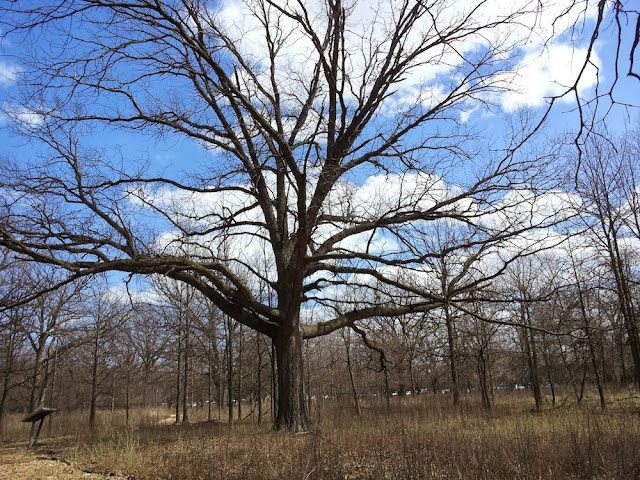

This time, it was lushly dressed.
I didn't see any snakes this time, as I had in April. When I was a kid, I loved finding pretty, sweet little garter snakes in our tiny front yard. At North Park, a lady walking by pointed this one out.

I picked it up gently, assuring a family watching nearby that it wouldn't bite, and one girl bravely held it herself--those are her hands in the picture. A month after this walk I participated in a restoration project in McHenry County, where the garter snakes are significantly more feisty, apparently, because I picked one up and it nipped me, drawing blood. I'm really glad I didn't get those kids bitten by a snake. That would have been embarrassing.
There are interpretive signs throughout the reserve, though some are quite weathered, and information about volunteers' restoration efforts.


I went to the center on a brutally hot day in July to chat (indoors) with the resident educators there, Liza and Sean. They have tirelessly created a multitude of ways to engage with children of all ages. There is a Maple Syrup Festival in the spring, where children learn all about sap and then help tap trees, and Monarchpalooza in the fall, where kids observe butterflies' life cycles and then help tag and release those ready for migration. There are interpretive encounters with birds, bees, trees, bugs, plants, and woodland mammals for school groups and families. Kids participate in conservation and restoration days through the park district's Mighty Acorns and an organization called El Valor, which has sort of adopted North Park as the location for some of its community-building goals. Sean and Liza have created Neighborhood Naturalists, a multi-season, multi-visit program for third grade classrooms. And of course there are camps all summer.
The Center also supports new, independent program ideas--Sean told me one woman organized some open-play mornings for children, in the middle of winter. Everyone was a little anxious about the lack of structure and the freezing temperatures, but the children found plenty to do and weren't bothered at all by the cold.
Community activities for adults abound, as well. There are yoga, fly-fishing, and art classes, story-guild nights and lectures.
I love coming to this urban Island of Children Playing in the Woods. Wouldn't it be amazing if this were what our classrooms looked like? What if kids of all ages read and wrote about seasons, used trees and hills to measure and calculate, leaves and breeze to learn about gravity and friction?

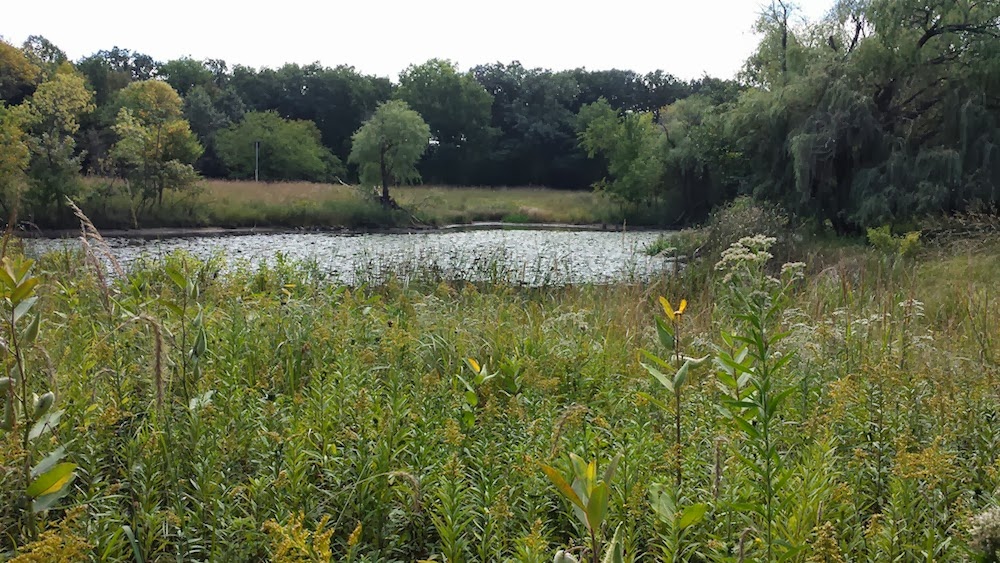
This pond can be seen from the Wetlands area, which is one of my favorite locations in the preserve. Here's the wetlands path in two seasons.


It looked so different today from my April visit, when foliage were dried, flattened stalks. The variety and wild abundance of plants today was impressive.


You couldn't see anything over this wall of foliage. I think the pond was behind there--in the spring it looked something like this.

I love the North Park Village wetlands in their wintry state, too, though. On mild days in the winter and spring, it's the sunniest, warmest place around.
Around the education center in the Woodland area, near the bird blind, the cicadas were out in force. I never noticed this bird blind before.

Near it are feeders, and inside it are signs about different bird types and behaviors you might see according to season.
When I visited in April, there had been abundant rain, and the west side of the woodland area had flooded.


It was much friendlier looking today.
Deer are often visible in the woodlands area. I know they're very common--a pest in many areas, a danger because of road collisions--but I still find them majestic and calming. You can see them any time of year. Look carefully: there are two visible in each picture. I wonder if they are the same two?


The Nature Reserve is a real respite from concrete, but we are still in the city, hemmed in on the west and the north by busy thoroughfares, and the traffic sounds are intrusive, especially near the woodland area. My eyes need to not-see concrete, and I love coming to the preserve for that. But my ears need to not-hear city din, and that's harder to accomplish in Chicago.
The Oak Savannah area hosts my favorite tree. I always make sure to go by and say hello.


This time, it was lushly dressed.
I didn't see any snakes this time, as I had in April. When I was a kid, I loved finding pretty, sweet little garter snakes in our tiny front yard. At North Park, a lady walking by pointed this one out.

I picked it up gently, assuring a family watching nearby that it wouldn't bite, and one girl bravely held it herself--those are her hands in the picture. A month after this walk I participated in a restoration project in McHenry County, where the garter snakes are significantly more feisty, apparently, because I picked one up and it nipped me, drawing blood. I'm really glad I didn't get those kids bitten by a snake. That would have been embarrassing.
There are interpretive signs throughout the reserve, though some are quite weathered, and information about volunteers' restoration efforts.


The Center also supports new, independent program ideas--Sean told me one woman organized some open-play mornings for children, in the middle of winter. Everyone was a little anxious about the lack of structure and the freezing temperatures, but the children found plenty to do and weren't bothered at all by the cold.
Community activities for adults abound, as well. There are yoga, fly-fishing, and art classes, story-guild nights and lectures.
I love coming to this urban Island of Children Playing in the Woods. Wouldn't it be amazing if this were what our classrooms looked like? What if kids of all ages read and wrote about seasons, used trees and hills to measure and calculate, leaves and breeze to learn about gravity and friction?
Wednesday, April 17, 2013
Outdoor learning in Seattle: Brightwater Environmental Education and Community Center
I wrote all about IslandWood, a Seattle area outdoor education center with a four-day school overnight program, in a previous post. While in Seattle I also visited Brightwater, a pretty awesome wastewater treatment plant serving King and Snohomish Counties that offers educational day programs. The facilities are maintained by King County, but the programming and staff are IslandWood affiliates.
Brightwater Treatment System opened in 2011 in Woodinville, WA on a site previously used for smelly industrial purposes. Residents were not necessarily thrilled at the prospect of replacing the soup factory and auto junkyard with a sewage treatment plant, but someone over at King County's wastewater treatment division had a vision. The plant goes beyond simply minimizing negative impact to actually contributing positively to the region's environmental health and community. You can learn all about it on one of their public tours.
In addition to the plant, the complex contains paths, ponds, native flora and fauna, and an education center with exhibits and labs.

The education center exists thanks to the cooperation of King County officials, environmental groups, local Native American groups, and a dedicated and tireless group of schoolteachers from the region called Friends of the Hidden River. These incredible teachers raised over a million dollars for the center! The platinum LEED certified education center, designed by Mithun (who also designed IslandWood), has a smorgasbord of environmental and sustainable features, including renewable energy sources for heat and reclaimed wood for construction.

Not that it's all been Woodinville wine and Pike Place roses...the project, which ran behind schedule and overbudget, was a source of concern and frustration for residents prior to its opening. It appears, though, that with two years of excellent programming for schools and the public, a clean and attractive facility, and a positive contribution to the ecological health of the region, residents are coming around.
The day program is for kids grades 3–8 (about 4400 of them this school year). The programs are aligned with area schools' science curriculum; the older kids study human impact on the water cycle at the treatment facility while the younger study landforms and ecosystems at the learning center and its nearby ponds and trails. The day I was there, I shadowed a group of third-graders.

We began the day in one of the classrooms, a spacious lab with a U-shaped desk arrangement, tables for lab work, and sinks, microscopes, and cabinets full of instruments. Our teacher for the day, Bonnie, talked with the group about food webs (a more accurate term than "food chains"), biodiversity, and the scientific method.

The kids' task was to count the types of water bugs in two different ponds to determine which pond has greater biodiversity. Bonnie distibuted observation journals and kid-sized clipboards, and the group headed outside to observe weather conditions, flora and fauna, and natural and man-made features in each pond that could affect water bugs' survival.

They collected water bugs in nets and placed them in containers filled with pond water.
Back at the lab, they used various tools to identify and log different types of bugs. Some bugs were the size of pinpoints and others were as large as my fingernail.

Our group found that Storm pond had more types of water bugs, but the adjacent classroom found more diversity in Otter Pond. I was expecting Bonnie to allow that one or the other was correct and to lead us in a reasoning out where the incorrect group might have gone wrong--but, instead, she explained that neither she nor the rest of the staff know the answer, that this is an ongoing science investigation and that the students' data will be logged as part of it. The kids' work has a purpose!
Forgive my excitement. It's so rare that schoolkids are asked to contribute to answering an as-yet unanswered question. And here they are also experiencing important scientific practices such as withholding conclusions while sufficient data is collected and staying open to unexpected results.
(The investigation isn't perfect: There are many variables that are not controlled, such as collection locations along the shore and students' netting technique; and, while the students are indeed contributing to answering a scientific question, it is not clear to me how much value, outside of educational, this particular question has. But I was still happily struck that students' results are logged and discussed as input toward unanswered question.)

After the kids had left for the day, the Brightwater staff--four classroom educators, the lead educator, Derek, and the program manager, Kate--gathered for their daily afternoon check-in. They compared the day's findings with each other, and then those findings with previous days; they swapped bug-container placement techniques and marveled over bug sizes. These adults were as engaged with the experience as the kids were.
Then the group turned to the teaching and learning. They traded tips about activities and pacing, shared challenges and solutions, and helped each other build or reinforce subject-matter knowledge. Kate asked about some journal pages that had just been added to help kids clear a stumbling block the staff had identified at earlier check-ins. The new pages got a unanimous thumbs-up--they provided just the scaffolding needed. If they hadn't, the staff would have tweaked and tested them until they were effective.
If you've ever been a part of any human organization at all, be it a marriage or a corporate office, you know that having regular, brief, informal check-ins to shore up strengths, identify trouble spots, and remain properly oriented is vital--and rare, and difficult to do consistently, and tricky to steer down the middle between kvetch session and social event. But the check-in I saw was an inspired check-in. It seemed to me that this unassuming and mostly hidden component of the Brightwater day was key to the success of the center. I could tick off ten helpful things that each staff member learned, either as a group or for his or her individual practice, in those twenty minutes. And each day the tips, lessons, and tweaking and testing are repeated. Imagine if the expectations and budgets for schools and teachers allowed for twenty minutes at the end of each day for staff to connect and check-in, trade tips and tweaks, identify strengths and challenges. Imagine if student teachers had this level of support.
At Brightwater, there is no pre- or post-visit classroom component. That is, it is hoped that teachers and principals have the time, will, and know-how to effectively integrate the Brightwater experience into academic units. Bonnie, who was a middle-school classroom teacher before coming to IslandWood and Brightwater as part the University of Washington's graduate program, credits her experience through the grad program with changing how she thinks about the classroom. Experiential learning seems so integral--and doable--now, whereas it wasn't so much on the radar before. Imagine if all teacher education programs fostered the kind of change in thinking that Bonnie experienced. Outdoor and experiential learning would be natural and expected, a a part of formal education...and, as teachers moved into decision-making and leadership positions, increasingly feasible structurally and financially.
In the next blog we'll look at one K–8 school in Seattle that is making inroads toward this ideal, mostly because of its amazing curriculum director.
Brightwater Treatment System opened in 2011 in Woodinville, WA on a site previously used for smelly industrial purposes. Residents were not necessarily thrilled at the prospect of replacing the soup factory and auto junkyard with a sewage treatment plant, but someone over at King County's wastewater treatment division had a vision. The plant goes beyond simply minimizing negative impact to actually contributing positively to the region's environmental health and community. You can learn all about it on one of their public tours.
In addition to the plant, the complex contains paths, ponds, native flora and fauna, and an education center with exhibits and labs.
 |
| The treatment plant is in the background; the nearer building is part of the education center |

The education center exists thanks to the cooperation of King County officials, environmental groups, local Native American groups, and a dedicated and tireless group of schoolteachers from the region called Friends of the Hidden River. These incredible teachers raised over a million dollars for the center! The platinum LEED certified education center, designed by Mithun (who also designed IslandWood), has a smorgasbord of environmental and sustainable features, including renewable energy sources for heat and reclaimed wood for construction.

Not that it's all been Woodinville wine and Pike Place roses...the project, which ran behind schedule and overbudget, was a source of concern and frustration for residents prior to its opening. It appears, though, that with two years of excellent programming for schools and the public, a clean and attractive facility, and a positive contribution to the ecological health of the region, residents are coming around.
The day program is for kids grades 3–8 (about 4400 of them this school year). The programs are aligned with area schools' science curriculum; the older kids study human impact on the water cycle at the treatment facility while the younger study landforms and ecosystems at the learning center and its nearby ponds and trails. The day I was there, I shadowed a group of third-graders.

We began the day in one of the classrooms, a spacious lab with a U-shaped desk arrangement, tables for lab work, and sinks, microscopes, and cabinets full of instruments. Our teacher for the day, Bonnie, talked with the group about food webs (a more accurate term than "food chains"), biodiversity, and the scientific method.

The kids' task was to count the types of water bugs in two different ponds to determine which pond has greater biodiversity. Bonnie distibuted observation journals and kid-sized clipboards, and the group headed outside to observe weather conditions, flora and fauna, and natural and man-made features in each pond that could affect water bugs' survival.

They collected water bugs in nets and placed them in containers filled with pond water.
 |
| Stream-fed Otter Pond is naturally occurring, but has some man-made features, such as a culvert |
 |
| Storm Pond is man-made, fed through pipes by rainwater funneled from buildings |

Our group found that Storm pond had more types of water bugs, but the adjacent classroom found more diversity in Otter Pond. I was expecting Bonnie to allow that one or the other was correct and to lead us in a reasoning out where the incorrect group might have gone wrong--but, instead, she explained that neither she nor the rest of the staff know the answer, that this is an ongoing science investigation and that the students' data will be logged as part of it. The kids' work has a purpose!
Forgive my excitement. It's so rare that schoolkids are asked to contribute to answering an as-yet unanswered question. And here they are also experiencing important scientific practices such as withholding conclusions while sufficient data is collected and staying open to unexpected results.
(The investigation isn't perfect: There are many variables that are not controlled, such as collection locations along the shore and students' netting technique; and, while the students are indeed contributing to answering a scientific question, it is not clear to me how much value, outside of educational, this particular question has. But I was still happily struck that students' results are logged and discussed as input toward unanswered question.)

After the kids had left for the day, the Brightwater staff--four classroom educators, the lead educator, Derek, and the program manager, Kate--gathered for their daily afternoon check-in. They compared the day's findings with each other, and then those findings with previous days; they swapped bug-container placement techniques and marveled over bug sizes. These adults were as engaged with the experience as the kids were.
Then the group turned to the teaching and learning. They traded tips about activities and pacing, shared challenges and solutions, and helped each other build or reinforce subject-matter knowledge. Kate asked about some journal pages that had just been added to help kids clear a stumbling block the staff had identified at earlier check-ins. The new pages got a unanimous thumbs-up--they provided just the scaffolding needed. If they hadn't, the staff would have tweaked and tested them until they were effective.
If you've ever been a part of any human organization at all, be it a marriage or a corporate office, you know that having regular, brief, informal check-ins to shore up strengths, identify trouble spots, and remain properly oriented is vital--and rare, and difficult to do consistently, and tricky to steer down the middle between kvetch session and social event. But the check-in I saw was an inspired check-in. It seemed to me that this unassuming and mostly hidden component of the Brightwater day was key to the success of the center. I could tick off ten helpful things that each staff member learned, either as a group or for his or her individual practice, in those twenty minutes. And each day the tips, lessons, and tweaking and testing are repeated. Imagine if the expectations and budgets for schools and teachers allowed for twenty minutes at the end of each day for staff to connect and check-in, trade tips and tweaks, identify strengths and challenges. Imagine if student teachers had this level of support.
At Brightwater, there is no pre- or post-visit classroom component. That is, it is hoped that teachers and principals have the time, will, and know-how to effectively integrate the Brightwater experience into academic units. Bonnie, who was a middle-school classroom teacher before coming to IslandWood and Brightwater as part the University of Washington's graduate program, credits her experience through the grad program with changing how she thinks about the classroom. Experiential learning seems so integral--and doable--now, whereas it wasn't so much on the radar before. Imagine if all teacher education programs fostered the kind of change in thinking that Bonnie experienced. Outdoor and experiential learning would be natural and expected, a a part of formal education...and, as teachers moved into decision-making and leadership positions, increasingly feasible structurally and financially.
In the next blog we'll look at one K–8 school in Seattle that is making inroads toward this ideal, mostly because of its amazing curriculum director.
Tuesday, April 16, 2013
Islandwood: A couple corrections
An IslandWood educator, Maddi Sullivan, offered a few corrections to some inaccuracies in my blog post about IslandWood. I'm writing them here and also updating the original post:
1. The Mill Pond is technically down at the harbor, rather than where the Floating Classroom floats. Its sectioned off from the rest of the harbor and is how the big logs were transported from ships etc into the mill. During the waning tide the logs would get dumped and they'd enter the mill pond and the gate would be shut to keep them from exiting as the tide rose. The pond with the Floating Classroom was created during the time of the great mills but it was simply a small stream that was dammed for drinking water etc in the dry months. There would have been no way to get the logs from that pond up at higher elevation and a couple miles away, down to the mill via water.
2. We don't have rain boots for kids to borrow, but just about everything else: rain jackets and pants, warm fleece jackets, hats, gloves etc.
3. "in the dining hall, where kids serve themselves buffet style"---the kids actually eat family style, not buffet. So one kid brings platters of food to each table and everyone serves themselves from them.
Thanks, Maddi! I really appreciate the note.
1. The Mill Pond is technically down at the harbor, rather than where the Floating Classroom floats. Its sectioned off from the rest of the harbor and is how the big logs were transported from ships etc into the mill. During the waning tide the logs would get dumped and they'd enter the mill pond and the gate would be shut to keep them from exiting as the tide rose. The pond with the Floating Classroom was created during the time of the great mills but it was simply a small stream that was dammed for drinking water etc in the dry months. There would have been no way to get the logs from that pond up at higher elevation and a couple miles away, down to the mill via water.
2. We don't have rain boots for kids to borrow, but just about everything else: rain jackets and pants, warm fleece jackets, hats, gloves etc.
3. "in the dining hall, where kids serve themselves buffet style"---the kids actually eat family style, not buffet. So one kid brings platters of food to each table and everyone serves themselves from them.
Thanks, Maddi! I really appreciate the note.
Saturday, March 16, 2013
My Morning Judging Poetry Out Loud
A few weeks ago I served as a judge for Poetry Out Loud (I've been waiting to secure permission to publish a couple photos of the finalists before posting this blog, but it's not yet forthcoming; so, onward). This is a competition wherein high school students memorize and recite published poems of their choosing. The contest starts at the school level and then moves through regional and state tournaments, ending with a national competition in Washington, D.C.; I was a judge for the Chicago regionals, held in the calming and airy headquarters of the Poetry Foundation.
Specifically, I was the "accuracy judge." While the other three judges evaluated students on style, clarity, and other such subjective elements, I was to follow the text of the poem during each student's recitation and measure fidelity to the written form. Even pluralizing a word or saying "the" instead of "a" meant a loss in point value.
While I would have enjoyed watching the students' full presentation, which I couldn't do with the Weight of Accuracy in my hands, I was grateful my criteria for judging these hopeful, earnest kids were entirely objective. As soon as we started, though, I realized I couldn't hide behind the black-and-white of the text: out of the four of us, I looked like the Mean One. Nervously standing not more than five feet in front of me, the contestant would say "of" instead of "for" and I would act immediately, marking the error on the poem. There is no way the students couldn't see me do it. While the other judges took notes during the presentation, their moves were not tied so directly to a particular word or phrase, and they could have been writing something positive, of course. If my hand moved, it meant nothing but bad news. I effected my kindest and most benign expression as each student recited, but I they weren't fooled, and I had a job to do.
In the end, the students I would have picked as the third, second, and first place winners indeed came in third, second, and first, so all was right with the world. I was relieved that no one's lack of orientation to detail, betrayed by my scoring sheet, had destroyed their chance at national poetic fame.
It was a joy to be around adolescents again. My days of classroom teaching are over, for a number of reasons, but I sure do miss teenagers. I love how newly and momentously they feel and experience things, how much their own growth in their minds and perceptions rock them, how they begin to catch glimpses of their adult selves, and you can see their comportment shift subtly accordingly. And it turns out all of those qualities are in evidence when they recite poetry.
Specifically, I was the "accuracy judge." While the other three judges evaluated students on style, clarity, and other such subjective elements, I was to follow the text of the poem during each student's recitation and measure fidelity to the written form. Even pluralizing a word or saying "the" instead of "a" meant a loss in point value.
While I would have enjoyed watching the students' full presentation, which I couldn't do with the Weight of Accuracy in my hands, I was grateful my criteria for judging these hopeful, earnest kids were entirely objective. As soon as we started, though, I realized I couldn't hide behind the black-and-white of the text: out of the four of us, I looked like the Mean One. Nervously standing not more than five feet in front of me, the contestant would say "of" instead of "for" and I would act immediately, marking the error on the poem. There is no way the students couldn't see me do it. While the other judges took notes during the presentation, their moves were not tied so directly to a particular word or phrase, and they could have been writing something positive, of course. If my hand moved, it meant nothing but bad news. I effected my kindest and most benign expression as each student recited, but I they weren't fooled, and I had a job to do.
In the end, the students I would have picked as the third, second, and first place winners indeed came in third, second, and first, so all was right with the world. I was relieved that no one's lack of orientation to detail, betrayed by my scoring sheet, had destroyed their chance at national poetic fame.
It was a joy to be around adolescents again. My days of classroom teaching are over, for a number of reasons, but I sure do miss teenagers. I love how newly and momentously they feel and experience things, how much their own growth in their minds and perceptions rock them, how they begin to catch glimpses of their adult selves, and you can see their comportment shift subtly accordingly. And it turns out all of those qualities are in evidence when they recite poetry.
Subscribe to:
Posts (Atom)